Artist's concept of part of the planet K2-18b with a thick atmosphere, its star and the planet K2-18c in the background (Image courtesy Alex Boersma)

An article published in the journal “Astronomy & Astrophysics” describes a research on the star K2-18’s system. A team of researchers used the HARPS instrument at ESO’s La Silla observatory in Chile to study the exoplanet K2-18b, discovered in 2015, which could be a larger version of the Earth. The analysis of the data led to the discovery of a second exoplanet, which was called K2-18c, a little less massive and closer to its star therefore probably too hot to be in ​​its system’s habitable zone.

Rendering of the Earth after its collision with Theia (Image courtesy SwRI/Marchi)

An article published in the journal “Nature Geoscience” describes a research on the consequences for the Earth of the bombardment that followed the formation of the Moon. According to a team of the Southwest Research Institute (SwRI) led by Simone Marchi, the collisions that followed the one that led to the birth of the Moon kept on increasing the Earth’s mass for a longer time than previously thought.

Wright Mons on Pluto (Image NASA/JHUAPL/SwRI)

An article published in the journal “Icarus” describes a research that suggests new possibilities for the gravitational effects of trans-Neptunian celestial bodies to generate heat on other celestial bodies close enough such as in the case of Pluto and Charon. A team of researchers examined the influence of that type of heating on bodies that may have very low temperatures but that under certain conditions can host underground oceans whose duration could be lengthened.

Hubble Ultra Deep Field galaxies seen by MUSE (Image ESO/MUSE HUDF collaboration)

A series of 10 articles to be published in the journal “Astronomy & Astrophysics” describes various aspects of the deepest spectroscopic investigation ever carried out with the MUSE instrument installed on ESO’s Very Large Telescope (VLT) in Chile. An international team with many researchers focused on the Hubble Space Telescope’s Ultra Deep Field (HUDF) to measure distances and properties of 1,600 very dim galaxies, of which 72 were never detected before.

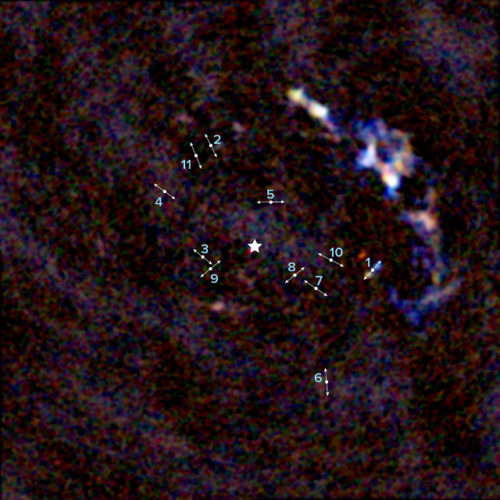
The protostars detected by ALMA (Image ALMA (ESO/NAOJ/NRAO), Yusef-Zadeh et al.; B. Saxton (NRAO/AUI/NSF))

An article published in the “Astrophysical Journal Letters” describes the discovery of protostars near the center of the Milky Way, near the supermassive black hole known as Sagittarius A* (or Sgr A*). A team of astronomers made this discovery using the ALMA radio telescope, a surprising result because the conditions in that area were considered too hostile due to the gravitational tides caused by Sgr A* and the intense electromagnetic emissions from the heated gas and dust ring around it.