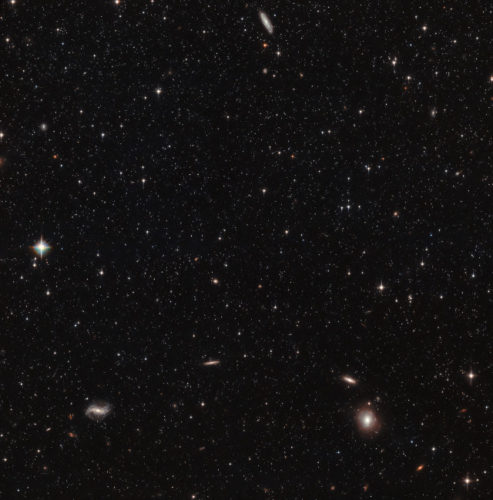
A part of the Sculptor Dwarf Galaxy (Image ESA/Hubble & NASA)

An article published in the journal “Nature Astronomy” reports the reconstruction of the 3D movements of 10 stars in the Sculptor Dwarf Galaxy selected within a larger sample of over 100 among those with the smallest measurement errors. A team of researchers used observations made using the Hubble Space Telescope in 2002 and subsequent observations carried out by ESA’s Gaia space probe between 2014 and 2015 to produce this reconstruction that confirms the “cold” dark matter model.

Representation of neutrinos reaching IceCube (Image courtesy IceCube Collaboration)

An article published in the journal “Nature” describes the measurement of the probability that neutrinos will be absorbed by Earth depending on their energy and the amount of matter they pass through. The researchers of the IceCube Collaboration used the neutrino detector in Antarctica to better understand the behavior of these elusive particles.

Fractures in the Sirenum Fossae (Image ESA/DLR/FU Berlin, CC BY-SA 3.0 IGO)

ESA has released images captured by its Mars Express space probe that show the Mars area called Sirenum Fossae. The High Resolution Camera Stereo Camera (HRSC) camera allowed to take photos of an area whose appearance was determined by an ancient volcanic activity, with the result that a system of tectonic faults called graben in jargon stretched for thousands of kilometers on the red planet’s surface.

RSLs in Tivat Crater on Mars (Image NASA/JPL-Caltech/UA/USGS)

An article published in the journal “Nature Geoscience” describes a research in which a team of researchers argues that the signs of liquid water flows found on Mars are actually made up of dry sand. The possible existence of what are technically called RSLs (recurring slope lineae), streaks of sand washed by liquid water, was announced in September 2015 by NASA. A new study of data collected by NASA’s MRO (Mars Reconnaissance Orbiter) space probe may, however, show a different situation.

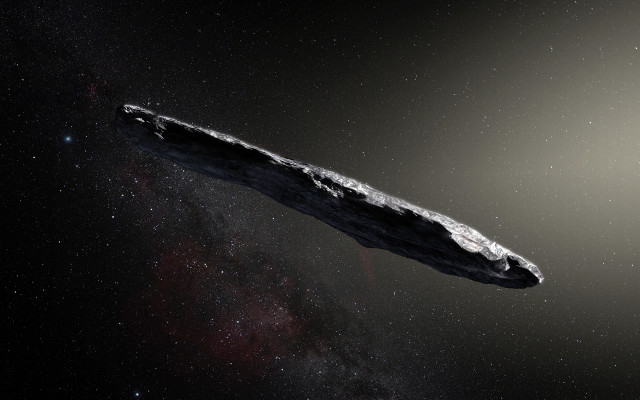
Artist's impression of interstellar asteroid 'Oumuamua (Image ESO/M. Kornmesser)

An article published in the journal “Nature” describes the observations carried out on ‘Oumuamua, the named given to the interstellar asteroid whose discovery was announced only a few weeks ago. It was designated as A/2017 U1 but after the creation of a new class of objects for interstellar asteroids its designation was modified into 1I/2017 U1. Observations with ESO’s VLT (Very Large Telescope) and other telescopes showed that it’s likely dense, rocky, reddish and with a very elongated shape.