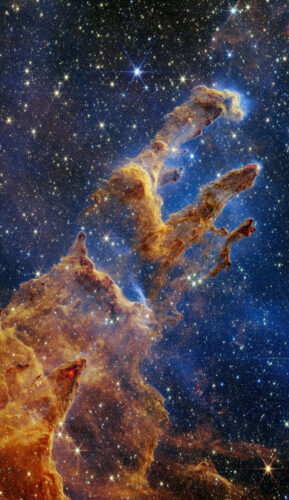
The Pillars of Creation seen by James Webb Space Telescope (Image NASA, ESA, CSA, STScI; J. DePasquale, A. Koekemoer, A. Pagan (STScI))

The so-called Pillars of Creation have been portrayed in some of the iconic images captured by the Hubble Space Telescope. Now the James Webb Space Telescope obtained even more detailed views of that star-forming area that is part of the Eagle Nebula. Webb’s infrared sensitivity can see even inside dust clouds where there are newborn stars and areas where stars are forming. That hasn’t only made it possible to obtain even more spectacular photos but also to provide a lot of new information useful to improve the models concerning star formation.

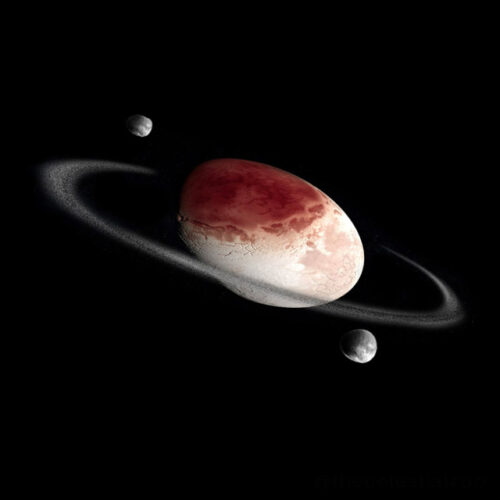
An artistic representation of Haumea with its moons Hiʻiaka and Namaka, which are actually much farther away from it, and its ring

An article published in the “Planetary Science Journal” reports the results of simulations that reproduce the possible history of the dwarf planet Haumea that led to its peculiar oval shape. A team of researchers used the geophysical and geochemical data available on Haumea and the asteroids that form a family with this dwarf planet to understand what processes led to their formation and evolution. The simulations lead to a reconstruction of the process that resulted in Haumea’s remarkable fast spin, which in turn led to its present shape.

The GRB221009A gamma-ray burst observed by Swift (Image NASA/Swift/A. Beardmore (University of Leicester)

A record-breaking gamma-ray burst was observed thanks to a series of space and ground-based telescopes on October 9, 2022. The fast global alert system existing among astronomical organizations made it possible to use several instruments to detect the event and its consequences over the next few days. Cataloged as GRB221009A, it’s already been called the gamma-ray burst of the century because it was very powerful even by the standards of these extremely energetic events. It may have been caused by a supernova that gave birth to a black hole but studies of the information collected have just begun.

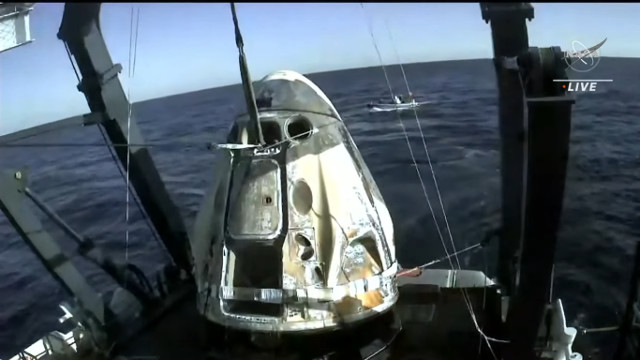
The Crew Dragon Freedom spacecraft on the ship Megan (Image NASA TV)

A few hours ago, SpaceX’s Crew Dragon Freedom spacecraft concluded its Crew-4, or SpaceX Crew-4, mission on behalf of NASA by splashing down without problems. On board were astronauts Jessica Watkins, Bob Hines, Kjell Lindgren, and Samantha Cristoforetti, who had reached the International Space Station on April 27 and were part of Expedition 67 and 68. The four of them completed SpaceX’s fourth regular crewed mission in the Atlantic Ocean off the coast of Jacksonville, Florida. The Crew Dragon departed the Station about six hours earlier.

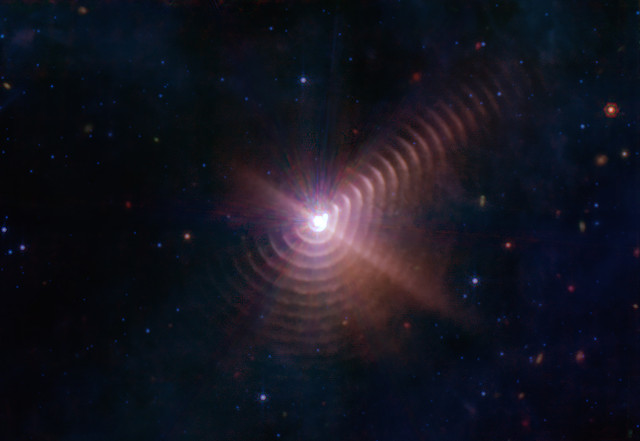
WR 140, its companion, and the rings around them (Image NASA, ESA, CSA, STScI, JPL-Caltech)

An article published in the journal “Nature Astronomy” reports the observation of 17 dust rings around WR 140, a so-called Wolf-Rayet star that has a very young and massive companion. A team of researchers used the James Webb Space Telescope’s MIRI instrument to study the area around this pair of stars, obtaining results far superior to those of other instruments, which had only identified two rings. According to the researchers, the rings are generated when the two stars get closer and their stellar winds interact violently causing the gas to compress, as it also contains elements heavier than hydrogen and allows it to form dust.