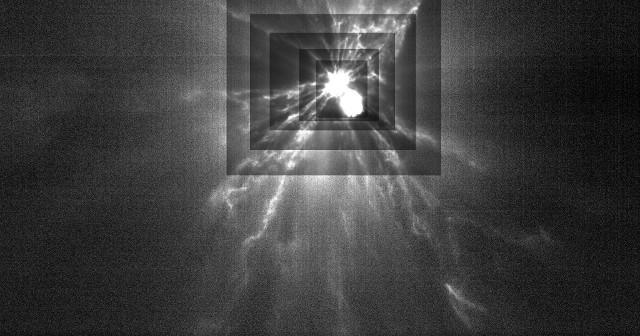
Asteroid Dimorphos and the ejected materials seen by LICIACube (Image ASI/NASA/APL)

In a press conference, NASA confirmed the success of its DART mission after ascertaining that the orbit of asteroid Dimorphos was changed by the impact of the spacecraft. According to calculations, Dimorphos now orbits the asteroid Didymos in 11 hours and 23 minutes while before the impact, it took 11 hours and 55 minutes for each orbit. The margin of error is approximately 2 minutes, which indicates that the success is far greater than the minimum predicted. The monitoring will continue, especially by the LICIACube mini-probe, to obtain more precise data, also on the materials ejected after the impact, as their characteristics will help to understand the composition of Dimorphos.

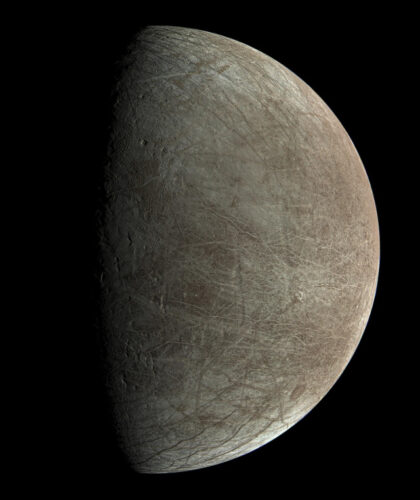
Europa seen by the Juno space probe (Image data: NASA/JPL-Caltech/SwRI/MSSSImage processing by Björn Jónsson)

NASA has released images of Europa, one of Jupiter’s so-called Galilean satellites, captured by its Juno space probe during a flyby conducted on September 29. The JunoCam was the main instrument for this task but for the occasion, a close-up shot was also captured by the SRU (Stellar Reference Unit), an instrument generally used to orient Juno by observing the stars. The photos taken by JunoCam were processed by some of the so-called citizen scientists, amateurs who contribute following their personal passion.

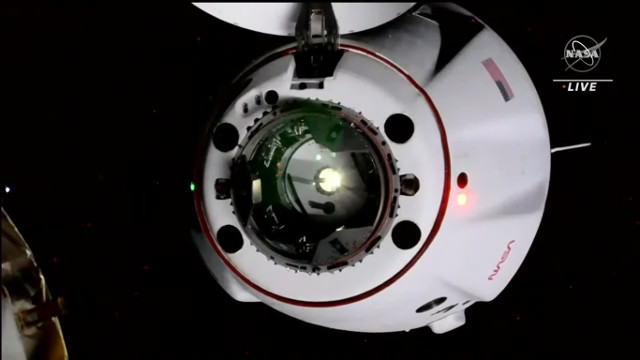
The Crew Dragon Endurance spacecraft approaching the International Space Station in its Crew-5 mission (Image NASA TV)

A few hours ago, SpaceX’s Crew Dragon Endurance spacecraft docked with the Harmony module of the International Space Station completing the first part of its Crew-5 or SpaceX Crew-5 mission that began with its launch about 29 hours earlier. After checking that the pressure was properly balanced, the hatch was opened to allow Koichi Wakata, Nicole Mann, Josh Cassada, and Anna Kikina to enter the Station.

SpaceX's Crew Dragon Endurance spacecraft blasting off atop a Falcon 9 rocket in its Crew-5 mission (Image NASA TV)

A little while ago, SpaceX’s Crew Dragon Endurance spacecraft blasted off atop a Falcon 9 rocket from the Kennedy Space Center in its Crew-5 or SpaceX Crew-5 mission. After almost exactly twelve minutes, it successfully separated from the rocket’s last stage and went en route to carry out its mission. This is the 5th crewed mission of the Crew Dragon spacecraft within the normal rotation of the International Space Station crew. This is also the second mission for the Endurance.

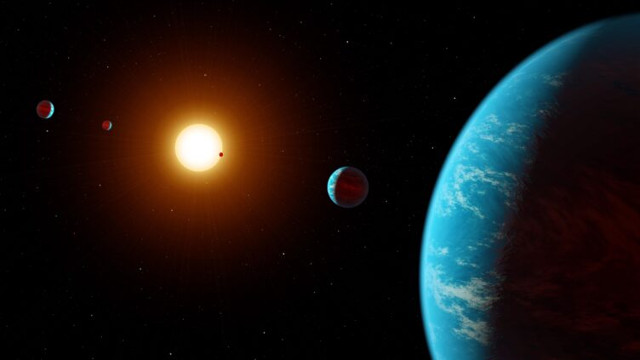
Artist's concept of a 5-Exoplanet system (Image NASA/JPL-Caltech))

An article published in the journal “Astronomy & Astrophysics” reports the confirmation of the presence of 5 rocky planets in the HD 23472 star system. A team of researchers used the Espresso spectrograph on ESO’s VLT to examine these exoplanets to estimate their masses using the radial velocity method. Their sizes were already known thanks to the data collected by NASA’s TESS space telescope, which observed their transit in front of their star. The result of the examination is that three of those exoplanets are super-Earths and two are probably super-Mercuries, rare cases characterized by a larger iron core and in general a high percentage of iron.