Artist's concept of the exoplanet TOI-1452 b (Image courtesy Benoit Gougeon, Université de Montréal)

An article published in “The Astronomical Journal” reports the discovery of a so-called ocean planet cataloged as TOI-1452 b. A team of researchers used observations conducted with NASA’s TESS space telescope and confirmation obtained using follow-up observations conducted with other instruments to locate and subsequently estimate the characteristics of this super-Earth that could be completely covered by an ocean. Its relative proximity to Earth and its position make it an excellent target for further observations, including with the James Webb Space Telescope.

The dwarf galaxy NGC 1156 seen by Hubble (Image ESA/Hubble & NASA, R. B. Tully, R. Jansen, R. Windhorst)

An image captured by the Hubble Space Telescope portrays the dwarf galaxy NGC 1156, a truly unique object because it’s an irregular dwarf galaxy that has various characteristics that belong to different classes of galaxies. Typically, galaxies that are out of the ordinary are the result of interactions or mergers, which are sometimes still in progress and offer the possibility to see the shapes of the original galaxies. NGC 1156 is among other things an isolated galaxy, and that means that there are no other galaxies close enough to affect its shape with a much higher force of gravity.

Jupiter seen through three filters applied to the James Webb Space Telescope's NIRCam (Near-Infrared Camera) instrument

NASA has published some photos of Jupiter captured by the James Webb Space Telescope that offer new information on the processes taking place within the largest planet in the solar system. The combination of different infrared filters leads to various results that allow appreciating new details of Jupiter. The colors are different from the real ones precisely because Webb detected them using infrared filters but the results are very interesting for the information they offer on storms, auroras, and various processes taking place on the planet and within it. Some images also include its rings and some of its moons.

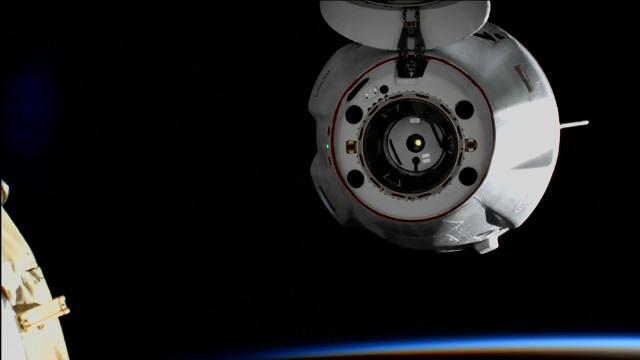
The Dragon cargo spacecraft departing the International Space Station to end its CRS-25 mission

Yesterday, in the American afternoon, SpaceX’s Dragon spacecraft ended its CRS-25 (Cargo Resupply Service 25) mission for NASA splashing down smoothly off the Florida Coast. The Dragon left the International Space Station last Friday. For SpaceX, this was the 5th mission of the 2nd contract with NASA to transport supplies to the Station with the new version of the Dragon cargo spacecraft.

Shortly after the splashdown, SpaceX’s recovery ship went to retrieve the Dragon to transport it to the coast. The cargo brought back to Earth will be delivered to NASA within a few hours. The Dragon spacecraft reached the International Space Station on July 16, 2021.

At the center the stars R136a1, R136a2 and R136a3 seen by the Zorro instrument in visible light

An article accepted for publication in “The Astrophysical Journal” reports a study on the star R136a1, perhaps the most massive known. A team of researchers pushed the Zorro instrument mounted on the Gemini South telescope to its limits to observe R136a1, or RMC 136a1. The results suggest that it’s less massive than previously estimated, as it was thought to be even more than 300 times the Sun’s mass. It remains a colossus given that the new estimate peaks in probability at 196 times the Sun’s mass. Two “siblings” may also be less massive than previously estimated, as this study estimates the mass of the star R136a2 to be about 151 times the Sun’s and the mass of the star R136a3 to about 155 times the Sun’s. Understanding these huge stars better helps to better predict their end and the chemical elements that will be created at that stage.