Comets

The comet 67P/Churyumov-Gerasimenko on October 18, 2015 (Photo ESA/Rosetta/NavCam)

An article just published in the journal “Nature” describes the discovery of oxygen molecules in the coma of the comet 67P/Churyumov-Gerasimenko. It’s a surprising discovery, and in fact is the first time that this presence is detected in a comet because molecular oxygen is very reactive so it tends to combine for example with hydrogen to form water. This oxygen is a “survivor” from the time of formation of the solar system.

Comet Lovejoy aka C/2014 Q2 on February 12, 2015 (Photo courtesy Fabrice Noel)

An article just published in the journal “Science Advances” describes a research about Comet Lovejoy, cataloged as C/2014 Q2. A team of researchers led by Nicolas Biver at the Observatoire de Meudon, France, analyzed the compounds emitted together with water when the comet passed close to the Sun, on January 30, 2015, and found 21 different organic molecules including ethyl alcohol and glycolaldehyde, a simple sugar.

On the left, OSIRIS images used to visually identify over 100 terraces (green). In the middle, a 3D shape model used to determine the directions in which the terraces/strata are sloping and to visualise how they extend into the subsurface. On the right, local gravity vectors visualised on the comet shape model perpendicular to the terrace/strata planes (Image ESA/Rosetta/MPS for OSIRIS Team MPS/UPD/LAM/IAA/SSO/INTA/UPM/DASP/IDA; M. Massironi et al (2015))

At the European Planetary Science Congress going on these days in Nantes, France, evidence were presented that the strange shape of the nucleus of comet 67P/Churyumov-Gerasimenko is due to the fact that it was born from the merger of two small comets occurred a few billion years ago. The study conducted by a team led by Matteo Massironi, a researcher at the University of Padua and Italian INAF (National Institute of Astrophysics) associate, was published in the journal “Nature”.

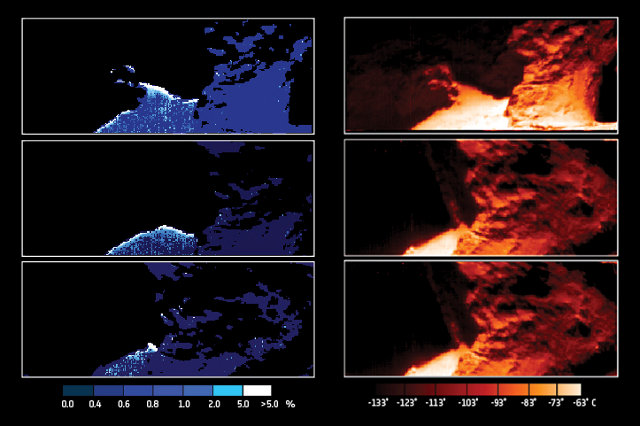
Maps of water ice abundance (left) and surface temperature (right) focusing on the Hapi ‘neck’ region of Comet 67P/Churyumov–Gerasimenko (Image ESA/Rosetta/VIRTIS/INAF-IAPS/OBS DE PARIS-LESIA/DLR; M.C. De Sanctis et al (2015))

An article just published in the journal “Nature” describes a research on the daily water-ice cycle on the surface of the comet 67P/Churyumov-Gerasimenko and its vicinity. A team of scientists led by Maria Cristina De Sanctis from Rome’s IAPS-INAF (National Institute of Astrophysics – Institute for Astrophysics and Space Planetology) analyzed data collected by the ESA’s Rosetta space probe’s VIRTIS spectrometer discovering that in some areas the ice water disappears in the day and reappears in the night.

Examples of the fractures detected on the surface of the comet 67P/Churyumov-Gerasimenko (Image ESA/Rosetta/MPS for OSIRIS Team MPS/UPD/LAM/IAA/SSO/INTA/UPM/DASP/IDA)

While the comet 67P/Churyumov-Gerasimenko started moving away from the Sun, new studies have been published based on data collected over the past months. An article published in the journal “Geophysical Research Letters” describes the exam of the many fractures photographed after the arrival of ESA’s space probe Rosetta. Another article published in the journal “Annales Geophysicae” provides an explanation for the “song” of the comet discovered last year.