Comets

An article published in “The Astrophysical Journal Letters” describes an analysis conducted on data collected by ESA’s Rosetta space probe’s ROSINA instrument that allowed to established that the ice on the comet 67P/Churyumov-Gerasimenko has a crystalline form. It may seem a trivial problem, however such nature implies that it originated in the protosolar nebula and is as old as the solar system.

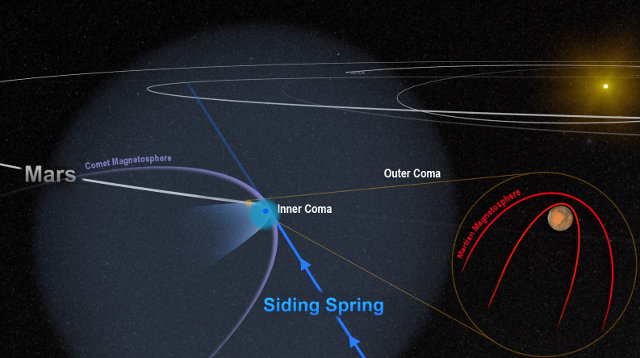
Scheme of the comet C/2013 A1 Siding Spring passing near Mars (Image NASA/Goddard)

An article published in the journal “Geophysical Research Letters” describes the effects on the planet Mars’ magnetic field caused by the close passage of the comet C/2013 A1 Siding Spring in October 2014. Using data collected in that period by NASA’s MAVEN space probe it was possible to reconstruct the moments that were chaotic for the Martian magnetosphere with profound consequences even if temporary.

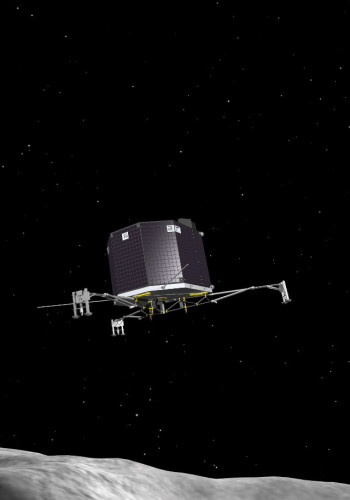
Artist's impression of the Philae lander (Image ESA–J. Huart)

The hopes to be able to contact the lander Philae on the comet 67P/Churyumov-Gerasimenko’s surface have now faded and ESA is also pessimistic. DLS, the German space agency, runs the LCC (Lander Control Center) and in recent months tried to re-establish contact after Philae communicated for a while on several occasions but issued a statement declaring that it’s time to say goodbye to the lander.

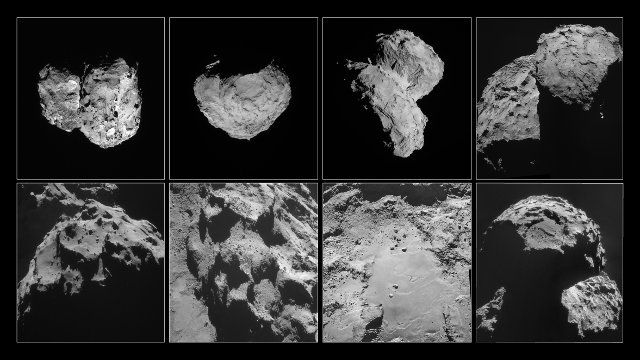
Pictures of the comet 67P/Churyumov-Gerasimenko taken by the Rosetta space probe between August and November 2014 (Image ESA/Rosetta/NavCam – CC BY-SA IGO 3.0)

An article published in the journal “Nature” describes a research about the internal structure of the comet 67P/Churyumov-Gerasimenko. A team of scientists, led by Martin Pätzold, from Rheinische Institut für Umweltforschung an der Universität zu Köln, Germany, analyzed data collected by ESA’s Rosetta space probe to provide some answers to the astronomers’ questions. According to their findings, the comet’s internal structure is quite homogeneous and contains no large caves. The total mass was estimated at nearly 10 billion tons.

Photos of the Imhotep region on the comet 67P/Churyumov-Gerasimenko where water ice on the surface was confirmed (Image ESA/Rosetta/NavCam – CC BY-SA IGO 3.0)

An article published in the journal “Nature” describes research that led to the confirmation of the presence of water ice exposed on the surface of the comet 67P/Churyumov-Gerasimenko. The VIRTIS instrument on ESA’s Rosetta space probe recorded the data that were analyzed to determine the composition of the surface top layer, which is mainly a dark material, dried and rich in organic substances containing a small part of water ice. On the comet there’s a lot of ice but it’s interesting to examine that on the surface because it allows us to understand better some of its creation processes, even underground.