Comets

Interstellar comet 2I/Borisov seen by Hubble (Image NASA, ESA, D. Jewitt (UCLA))

An article published in the “Astrophysical Journal Letters” reports the detection of what have been interpreted as traces of water emitted by interstellar comet 2I/Borisov. A team of researchers led by Adam McKay of NASA’s Goddard Space Flight Center used the Apache Point Observatory in New Mexico to study the light reflected from the comet detecting the “signature” of oxygen in large amounts. The most likely explanation for the presence of this element is that the ultraviolet light from the Sun broke the water molecules emitted into oxygen and hydrogen.

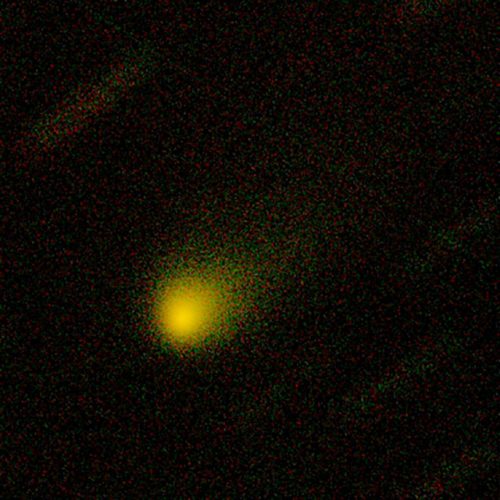
Interstellar comet 2I/Borisov (Image courtesy Gemini Observatory/Nsf/Aura)

An article published in the journal “Nature Astronomy” reports an initial characterization of interstellar comet 2I/Borisov, initially designated as C/2019 Q4. A team of researchers used data collected using the Gemini North on the island of Mauna Kea, in Hawaii, and the William Herschel Telescope in the Canaries. The data confirm it comes from another star system, yet it has characteristics very similar to the comets of the solar system.

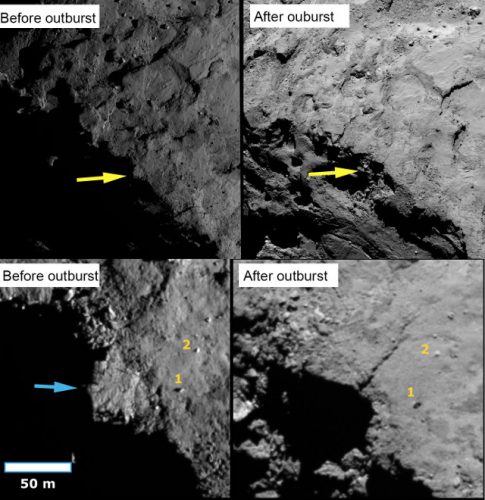
Collapsing cliffs and bouncing boulders on the surface of comet 67P/Churyumov-Gerasimenko

At the EPSC-DPS conference taking place in Geneva, Switzerland, new evidence was presented that on comet 67P/Churyumov-Gerasimenko there are collapsing cliffs and bouncing boulders. Some scientists examined the approximately 76,000 high-resolution photographs taken by the ESA’s Rosetta space probe’s OSIRIS camera to study the activity on the comet’s surface in the period in which it was active.

C/2019 Q4 seen by the Canada-France-Hawaii Telescope (Image courtesy C/2019 Q4 seen by the Canada-France-Hawaii Telescope)

An object cataloged as C/2019 Q4 (Borisov) and identified as a comet discovered on August 30 by the amateur astronomer Gennady Borisov has a strongly hyperbolic trajectory that suggests its interstellar origin. This could be the first identified interstellar comet, with the advantage that it was discovered while it was still approaching the Sun so it will be possible to conduct more observations for months.

A measurement of the temperatures on the surface of comet 67P/Churyumov-Gerasimenko

An article published in the journal “Nature Astronomy” reports a series of measurements of the temperature of comet 67P/Churyumov-Gerasimenko’s nucleus obtained thanks to ESA’s Rosetta space probe’s VIRTIS instrument. A team of researchers led by Federico Tosi of the National Institute of Astrophysics’ Space Astrophysics and Planetology Institute in Rome, Italy, used the infrared images captured by VIRTIS to generate thermal maps from which they obtained the temperatures reconstructing the daily and seasonal variations but also the ones related to its morphological characteristics and the chemical-physical characteristics of the top surface layer.