Cosmology

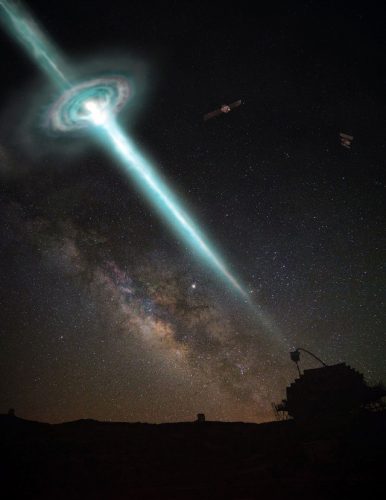
Artist's concept of gamma-ray burst (Image courtesy Superbossa.com e Alice Donini)

An article published in the journal “Physical Review Letters” reports a measurement of the invariance of the speed of light in vacuum at different energies thanks to observations of the gamma-ray burst cataloged as GRB 190114C, the most powerful ever observed. The scientists from the MAGIC Collaboration used the data collected by the two MAGIC telescopes in the Canaries to investigate in particular a phenomenon called Lorentz invariance violation (LIV), ending up with yet another confirmation of Albert Einstein’s theory of general relativity.

Illustration of the shock fron in the Eta Carinae system (Image courtesy DESY, Science Communication Lab)

An article published in the journal “Astronomy & Astrophysics” reports the detection of extremely energetic gamma-ray emissions from the Eta Carinae system. A team of researchers coordinated by the German national nuclear physics research center DESY used the HESS telescope system to detect those gamma rays and prove that they were generated by the collision of stellar winds from the two blue giant stars that make up this binary system. Various models have been proposed, and a study published in a second article on “Astronomy & Astrophysics” offers some evaluations that follow a reanalysis of data collected over time by various instruments.

Artist's concept of Pōniuāʻena (Image courtesy International Gemini Observatory/NOIRLab/NSF/AURA/P. Marenfeld)

An article accepted for publication in “The Astrophysical Journal Letters” reports the discovery of a very bright primordial quasar that was cataloged as J100758.264+211529.207, or simply J1007+2115, and named Pōniuāʻena. A team of researchers used three Mount Maunakea Observatories in Hawaii to identify one of the oldest known quasars, surpassed in age only by the one cataloged as J1342+0928, whose discovery was announced in December 2017.

From Earth we see Pōniuāʻena as it was about 13 billion years ago, a quasar powered by a supermassive black hole with an estimated mass of 1.5 billion times that of the Sun, almost twice the one that powers J1342+0928. This raises more than ever the problem of the quick growth of some primordial supermassive black holes.

Artist's concept of the GW190814 event

An article published in “The Astrophysical Journal Letters” reports a study on the origin of gravitational waves detected in the event cataloged as GW190814 on August 14, 2019, in which a black hole with a mass about 23 times the Sun’s merged with an object with a mass about 2.6 times the Sun’s whose nature is uncertain. The scientists of the LIGO and Virgo collaborations analyzed the data collected by the network of interferometers that recorded the gravitational waves emitted by that event. The problem is that the mass of the less massive object is within a gap where it’s not currently possible to say whether a compact object is a neutron star or a black hole.

The sky seen at X-rays by eROSITA

The Max Planck Institute for Extraterrestrial Physics (MPE) has published an X-ray universe map obtained thanks to the eROSITA instrument, which the institute built for the Spektr-RG space telescope. This map includes about a million objects related to the hot and energetic part of the universe. It’s about 4 times deeper than the previous map of this type and contains about 10 times the number of energy sources, the equivalent of those discovered by all X-ray telescopes combined in over half a century of observations. It took about six months for eROSITA to complete this survey, which is only the first of eight expected in the course of about four years that will offer information that is likely to be used for decades.