Cosmology

Coma Cluster (Image CTIO/NOIRLab/DOE/NSF/AURA. Image Processing: D. de Martin & M. Zamani (NSF NOIRLab)

An image captured by the Dark Energy Camera (DECam) depicts the Coma Cluster, also known as Abell 1656, so named because it’s part of the constellation Coma Berenices. DECam was designed to conduct a long-term investigation of dark energy but is also useful for other types of astronomical studies. The Coma Cluster is linked to the study of dark matter since the inconsistency between the estimate of its overall mass and the measurement of its gravitational effects stimulated the research that led to today’s dark matter models.

The three primordial galaxies (Image courtesy JWST/NIRSpec, Bingjie Wang/Penn State)

An article published in “The Astrophysical Journal Letters” reports the results of the study of three very compact primordial galaxies with characteristics that can’t be explained by current cosmological models. A team led by researchers from Penn State University used observations conducted with the James Webb Space Telescope within the RUBIES survey to examine three objects that were considered mysterious for their strange characteristics.

In an article published in the journal “Nature” the researchers had already proposed that those were galaxies, and the new examination of the data confirms that. We see them as they were when the universe was between 600 and 800 million years old but their emissions indicate that they contain stars that are already relatively old and supermassive black holes with masses that were already enormous, perhaps more than the one at the center of the Milky Way.

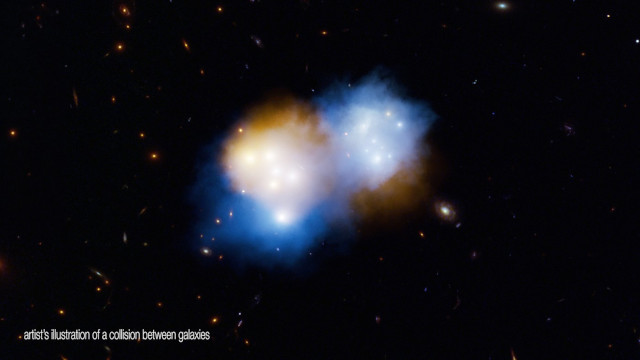
Artist's concept of MACS J0018.5 with dark matter in blue and baryonic matter in orange (Image courtesy W.M. Keck Observatory/Adam Makarenko)

An article published in the journal “The Astrophysical Journal” reports the results of a study on the ongoing merger between two galaxy clusters that are forming a single new cluster cataloged as MACS J0018.5+1626, or simply MACS J0018.5. A team of researchers used data obtained from observations dating back even decades conducted with various space and ground-based telescopes, analyzing them to decouple the behavior of ordinary matter and dark matter.

To measure the speed of intergalactic gas composed of normal matter, they used the kinematic Sunyaev-Zel’dovich (SZ) effect. The speed of dark matter is roughly the same as galaxies. The result is that dark matter moves faster than normal matter. This result offers clues about dark matter and its behavior that are useful in studies of its nature.

An artistic illustration of the test of the postquantum theory of classical gravity

An article published in the journal “Physical Review X (PRX)” proposes what is called a postquantum theory of classical gravity. Professor Jonathan Oppenheim of University College London (UCL) offers a different approach to that adopted by most of his colleagues by proposing to modify quantum theory to unify it with relativistic gravity. An article published in the journal “Nature Communications” offers some reflections from Professor Oppenheim’s former Ph.D. students on the consequences of his theory and proposes an experiment to verify it.

The Perseus galaxy cluster (Image ESA/Euclid/Euclid Consortium/NASA, image processing by J.-C. Cuillandre (CEA Paris-Saclay), G. Anselmi, CC BY-SA 3.0 IGO)

ESA has presented the first official images captured by its Euclid space telescope. After some delays due to problems with the fine guidance sensor, it was possible to calibrate Euclid’s instruments and obtain the extraordinary precision of observations necessary for its mission. The result is a resolution that allows a quantity of detail never seen before to be included in the images, be it galaxies, stars, or other objects, often discovered by Euclid. The presentation showed the results both with distant objects such as the Perseus galaxy cluster and with others close in astronomical terms such as the Horsehead Nebula.