Cosmology

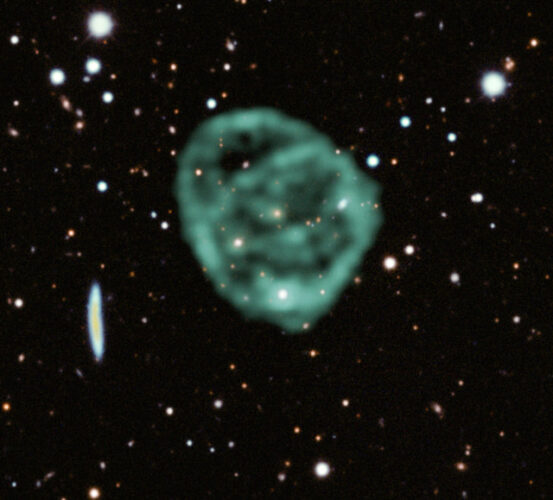
ORC1 seen by MeerKAT and in the background optical data from the Dark Energy Survey (Image J. English (U. Manitoba)/EMU/MeerKAT/DES(CTIO))

An article published in the journal “Monthly Notices of the Royal Astronomical Society” reports a study based on a new image of a so-called odd radio circle (ORC). A team of researchers used the MeerKAT radio telescope to observe this structure with a diameter of over one million light-years visible only at radio waves. Each new observation of this type of phenomenon offers new information, as only five of them are known at the moment. The information collected with MeerKAT could help verify the theories that were proposed and reach a reasonably certain explanation for its origin and nature.

A map of the of the cosmic microwave background radiation with the apparent anisotropies

An article published in “The Astrophysical Journal Letters” offers a solution to two of the major problems currently existing in the field of cosmology. Prabhakar Tiwari, Rahul Kothari, and Pankaj Jain propose the so-called superhorizon modes: modes in the sense of cosmic components and superhorizon as beyond the observable universe. The researchers believe that they can explain why the universe appears to us not entirely homogeneous and the so-called tension resulting from too different values ​​of the expansion universe expansion velocity resulting from different methods of calculating them.

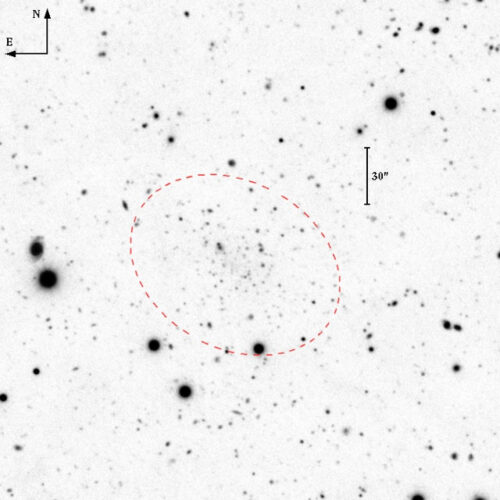
The dwarf galaxy Pisces VII seen by DOLoRes (Image courtesy W. Boschin/TNG)

An article published in the journal “Monthly Notices of the Royal Astronomical” reports the confirmation of the discovery of the dwarf galaxy Pisces VII, which could be a satellite of the Triangulum galaxy. A team of researchers led by David Martínez-Delgado of the Instituto de Astrofisica de Andalucia used the DOLoRes instrument at the Galileo National Telescope to confirm the existence of Pisces VII, originally identified by the amateur astronomer Giuseppe Donatiello. The gravitational bond with the Triangulum galaxy has yet to be verified but if the outcome were positive it would be a confirmation of the theories concerning galaxy formation, which predict the presence of various satellite galaxies. The reference is to the Lambda-CDM model, which also concerns dark matter.

Three galaxies simulated in the IllustrisTNG Project

An article published in “The Astronomical Journal” reports the first results of an analysis of the data of the Data Release 3 (DR3) of the Lega-C astronomical survey, the largest spectroscopic survey of galaxies that we could define in their midlife since we see them as they were between about five and eight billion years ago. It offers information crucial to fully understand certain phases of the evolution of galaxies and star formation within them. Good news offered by a team of researchers led by Po-Feng Wu of the Institute of Astronomy and Astrophysics in Taipei (Taiwan) is the good consistency between the simulations of the IllustrisTNG program and of the observations conducted in that sort of census that was Lega-C.

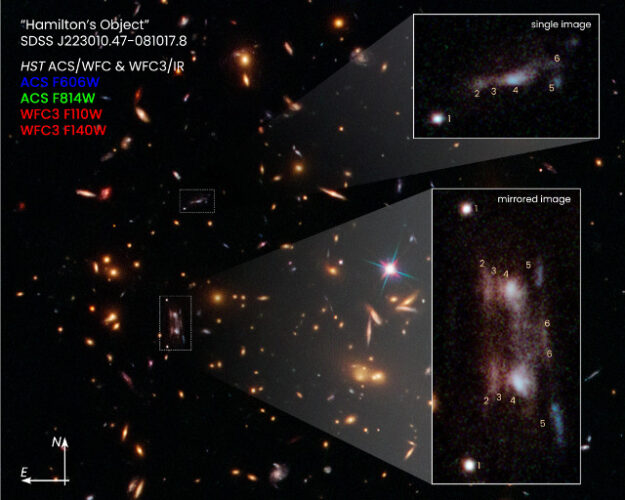
Hamilton's Object seen by Hubble

An article published in the journal “The Monthly Notices of the Royal Astronomical Society” reports a solution to an astronomical mystery involving two galaxies that appeared to be mirror images of each other and turned out to be two images of the same galaxy doubled by a gravitational lens. A team of researchers led by Richard Griffiths of the University of Hawaii at Hilo used observations made with the Hubble Space Telescope to obtain enough information to understand the nature of what was named Hamilton’s Object because it was discovered by astronomer Timothy Hamilton. Meanwhile, a third image of the galaxy was discovered, visible in another area of ​​the sky again thanks to the gravitational lens.