Cosmology

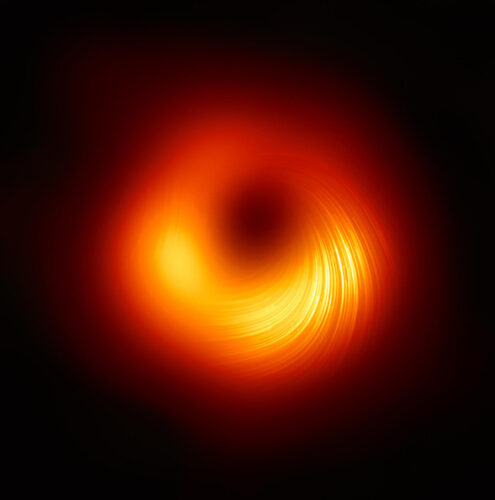
The area around the supermassive black hole of the galaxy M87 in polarized light

Two articles published in “The Astrophysical Journal Letters” report different aspects of a study that led to the representation of the area around the supermassive black hole at the center of the galaxy M87 in polarized light. Scientists from the Event Horizon Telescope Collaboration used data collected in 2017 to obtain a new image that offers new information on the structure of the magnetic fields around the supermassive black hole. A third article published in the same journal reports the details of the observations conducted with the ALMA radio telescope during the 2017 observation campaign.

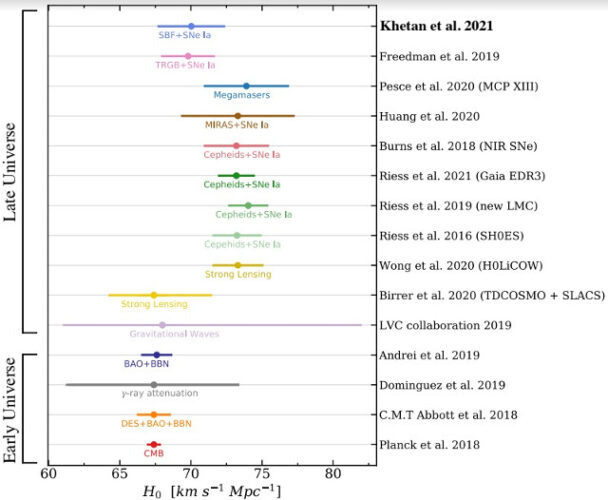
Different values of the Hubble constant

An article published in the journal “Astronomy & Astrophysics” reports a method to measure the expansion velocity of the universe that takes into account the differences between the type Ia supernovae used. A team of researchers led by Nandita Khetan, Ph.D. student at the Italian Gran Sasso Science Institute and associated with the Italian National Institute of Nuclear Physics, proposed a method to calibrate the distances of those supernovae using the surface brightness fluctuations (SBF) of their host galaxies. The result is closer to the ones already calculated with other methods than the one obtained without that calibration. It doesn’t solve the problem of very different values ​​of the so-called Hubble constant but suggests the possibility that the problem is due to instrumental inaccuracies and doesn’t require new physics.

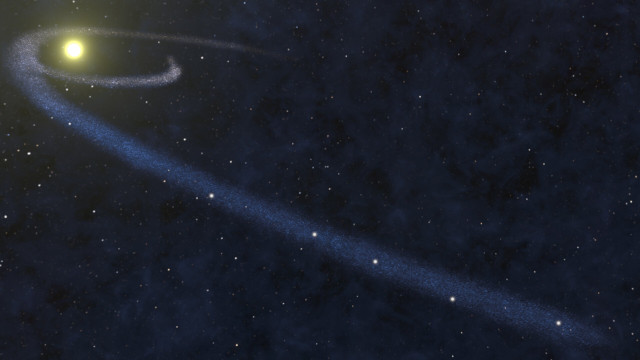
Artist's concept of a gas filament disrupted by a star

An article published in the journal “Monthly Notices of the Royal Astronomical Society” reports the detection of a hydrogen filament about three trillion kilometers long in the cosmic neighborhood. A team of researchers led by Yuanming Wang, a doctoral candidate at the Australian University of Sydney, and Dr. Artem Tuntsov of Manly Astrophysics, used the ASKAP radio telescope to discover this ultra-low-temperature gas just 13 light-years from the Earth. In recent years, a lot of gas that forms the baryonic matter considered to be missing has been discovered in filaments that unite different galaxies, in this case it’s inside the Milky Way and in astronomical terms very close.

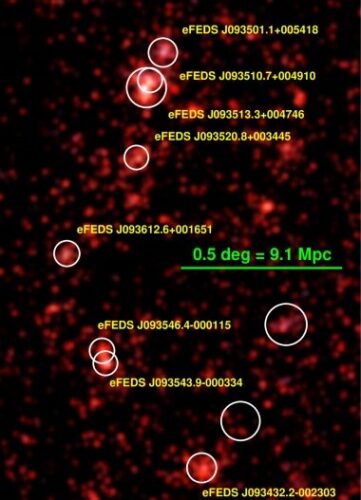
The sky area where the eROSITA instrument identified the eight galaxy clusters that form the new supercluster

An article to be published in the journal “Astronomy & Astrophysics” reports the discovery of a galaxy supercluster. A team of researchers led by Vittorio Ghirardini of the Max Planck Institute for Extraterrestrial Physics in Garching, Germany, analyzed data from the eFEDS survey conducted with the Spektr-RG space telescope’s eROSITA instrument identifying a structure composed of eight different galaxy clusters. Follow-up observations with the LOFAR and uGMRT radio telescopes made it possible to confirm that it’s a supercluster thanks to the identification of filaments that unite the various galaxies. The possibility of improving our knowledge of the cosmic filament web is one of the reasons why it’s important to find these superclusters.

Composed image of Abell 3391/95

An article published in the journal “Astronomy & Astrophysics” reports the discovery of a filamentary structure of hot gas connecting two galaxy clusters about 50 million light-years long. A team of researchers used data collected by the eROSITA instrument, the ASKAP radio telescope, and the DECam instrument to study a system of three galaxy clusters called Abell 3391/95 and found what is the longest filament ever discovered. Its estimated mass confirms that the so-called missing baryon matter could be in those filaments.