Stars

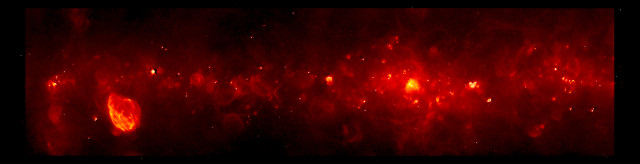
A map obtained from the GLOSTAR survey with a segment of the Milky Way disk

Four articles published in the journal “Astronomy & Astrophysics” report various aspects of the mapping of the northern galactic plane, which led, among other things, to the discovery of new areas of star formation in the Milky Way. Many researchers collaborated in the analysis of data collected within the GLOSTAR survey, which aims to examine star-forming regions within the galaxy using observations from the VLA and Effelsberg radio telescopes. The data made it possible to obtain the most detailed maps of the northern galactic plane at radio frequencies, which made it possible to identify the new star nurseries.

The PDS 70 system with the zoom on the protoplanet PDS 70 c

An article published in “The Astrophysical Journal Letters” reports a study on the circumplanetary disk around the exoplanet PDS 70 c. A team of researchers led by Myriam Benisty used the ALMA radio telescope to study what is still a protoplanet and the disk of materials around it that could form moons. According to estimates, there’s enough mass to form up to three moons the size of the Earth’s Moon. This type of study offers new information both on the formation of planets, especially gas giants, and on moons, one of the frontiers astronomers are trying to open.

The galaxies NGC 1300, and NGC 1087, NGC 3627 (top), NGC 4254 and NGC 4303 (bottom)

ESO has published some images created during the PHANGS project using the MUSE instrument on the VLT. These are images of galaxies in the nearby universe in which researchers from the PHANGS project tried to identify stellar nurseries. The aim is to get answers to the questions that still exist about star formation. For this reason, the investigation conducted with the MUSE instrument is a part of a larger project that includes other parallel investigations conducted with the ALMA radio telescope and the Hubble Space Telescope.

SMSS 2003-1142 at the center (Image courtesy Da Costa/SkyMapper)

An article published in the journal “Nature” reports the identification of what is considered a magnetorotational hypernova, the explosion of a very massive star with a powerful magnetic field and in rapid rotation. A team of researchers led by David Yong, Gary Da Costa, and Chiaki Kobayashi collected evidence of this type of hypernova for the first time. That was achieved by examining the data collected not directly but by investigating a mysterious red giant star discovered in the Milky Way halo and cataloged as SMSS J200322.54-114203.3, or simply SMSS 2003-1142, in which there are anomalous quantities of some chemical elements explainable as the product of a magnetorotational hypernova.

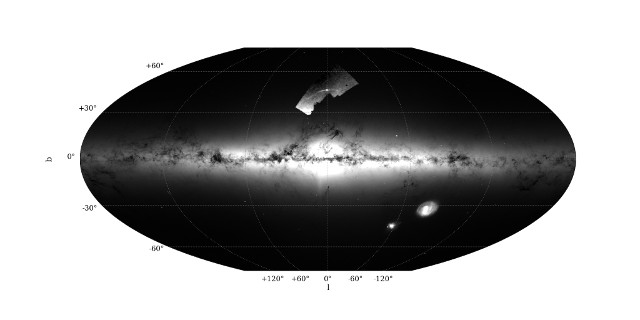
A view of the sky with Palomar 5 at the top-center

An article published in the journal “Nature Astronomy” reports a study on the star cluster Palomar 5 that indicates that in a billion years only black holes will remain inside it. A team of researchers led by Professor Mark Gieles of the University of Barcelona studied this ancient and very low-density cluster by conducting a series of simulations to try to predict its future. The number of black holes inside it is already above average today and is subject to gravitational interactions with the consequence that in the distant future its size will increase and only black holes will remain.