Stars

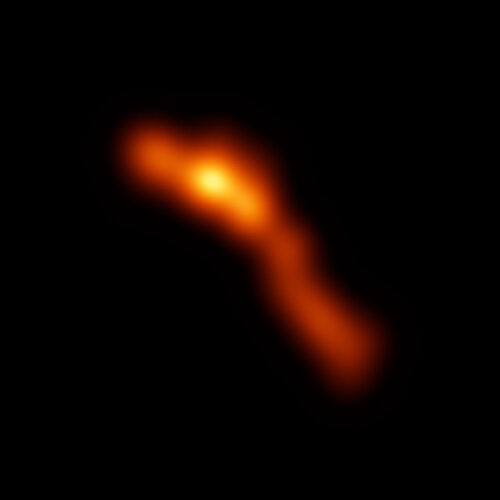
The jet from protostar Cep A HW2 seen by the VLA (Image Carrasco-Gonzalez et al., Bill Saxton, NRAO/AUI/NSF)

An article accepted for publication in the “Astrophysical Journal Letters” reports a study on the massive protostar Cep A HW2 and in particular on the jets of materials ejected from it. A team of researchers used the VLA to capture the best images so far of a protostar that, at the end of its formation, will likely be about 10 times more massive than the Sun. The details of the ejected jets indicate that they have an origin close to the star that has a wide angle and then tapers as the distance increases, a process called collimation. In lower-mass protostars, the collimation of the jets occurs much closer to their surface. Understanding the reason for this difference will help to better understand star formation processes.

The galaxy NGC 2276 (Image ESA/Hubble & NASA, P. Sell. Acknowledgement: L. Shatz)

An image captured by the Hubble Space Telescope shows the galaxy NGC 2276. It’s a spiral galaxy that shows some peculiarities, as its shape is a bit distorted and the colors that indicate the distribution of the stars inside it reveal a certain irregularity. The reason for that is the interaction with a neighbor, the galaxy NGC 2300, whose force of gravity distorted some of NGC 2276’s spiral arms. Another interaction also involves the intergalactic gas that is present in the cluster that includes these two galaxies, which crashed into NGC 2276 triggering a high rate of star formation on an outer side of this galaxy.

The distribution of the 36 dwarf galaxies around the Milky Way

An article published in “The Astrophysical Journal” reports the discovery of 36 dwarf galaxies that are simultaneously showing signs of the start of remarkable star-forming activity. A team of researchers examined a group of dwarf galaxies observed during the ANGST survey noting a simultaneous acceleration in star-forming activity despite the fact that they’re separated even by several million light-years. This is a phenomenon that has no explanation in current models of galaxy evolution.

The likely galaxies where the origins of fast radio bursts cataloged as FRB 190714 (top) and FRB 180924 (bottom) was located

An article to be published in “The Astrophysical Journal” reports the location of the origin of eight fast radio bursts (FRBs) detected between 2017 and 2020. A team of researchers coordinated by the University of California at Santa Cruz used the Hubble Space Telescope to accomplish this task by applying a method already used to pinpoint the origin of other cosmic phenomena such as supernovae and gamma-ray bursts. This result offers new information on an extremely energetic phenomenon such as fast radio bursts, which emit an amount of energy in a millisecond comparable to the amount the Sun emits in a year. The results of this study are compatible with the theory that links them to magnetars.

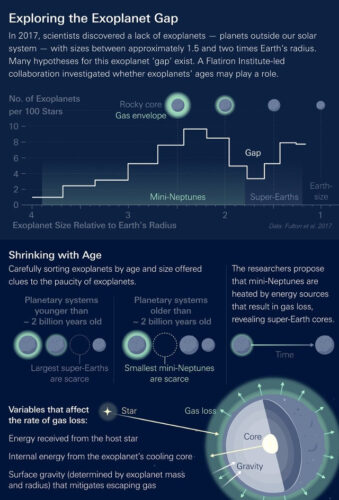
An infographic that illustrates the statistics of exoplanets with the radius gap and the possible mechanisms that make mini-Neptunes shrink until they turn into super-Earths

An article published in “The Astronomical Journal” reports a study on the scarcity of exoplanets with a radius between 1.5 and 2 times the Earth’s. A team of researchers led by Trevor David of the Flatiron Institute in New York studied what is commonly referred to as a radius gap using data collected by NASA’s Kepler Space Telescope. By dividing the exoplanets studied between those older than 2 billion years and those younger, the exam offers new information confirming the theory that sub-Neptunes can lose most of their atmosphere and transform into super-Earths even after billions of years.