Stars

Artist’s concept of Proxima Centauri during a superflare (Image NRAO/S. Dagnello)

An article published in “The Astrophysical Journal Letters” reports an analysis of a superflare of the star Proxima Centauri observed in 2019 in various bands of the electromagnetic spectrum. A team of researchers led by Meredith MacGregor of the University of Colorado at Boulder used various ground-based and space telescopes to obtain complete observations of a flare one hundred times more powerful than solar flares on the closest star to the Sun. It’s the most powerful flare ever observed on Proxima Centauri and one of the most powerful observed in the entire Milky Way.

AG Carinae (Image NASA, ESA and STScI)

A new photo of AG Carinae, a hypergiant star that belongs to the Luminous Blue Variable (LBV) class, captured by the Hubble Space Telescope has been released to celebrate the 31st anniversary of Hubble being deployed into orbit. The star is surrounded by a nebula formed by materials ejected from the star itself in a period in which instability caused one or more extremely powerful outbursts. The shell that was created is about five light-years across.

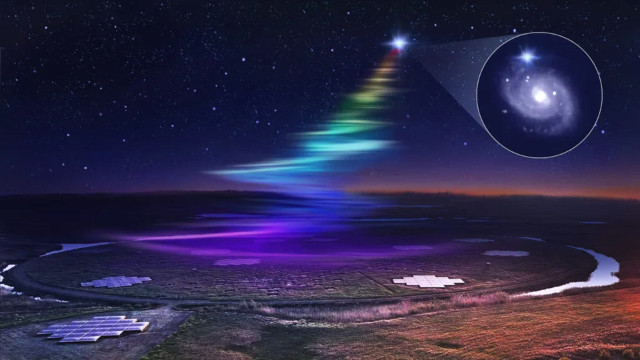
Artistic concept of the LOFAR radio telescope and fast radio burst FRB 20180916B (Image courtesy D. Futselaar / S.P. Tendulkar / ASTRON)

Two articles, one published in “The Astrophysical Journal Letters” and one published in “Nature Astronomy”, report various aspects of a research on the fast radio burst FRB 20180916B, whose emissions include the lowest frequencies at which such an event has been detected so far. Two teams of researchers with various members in common used detections obtained with the LOFAR radio telescope and the European VLBI network to study this fast radio burst that is repeating with a periodicity of just over 16 days. Its origin has been pinpointed in a small region around a neutron star.

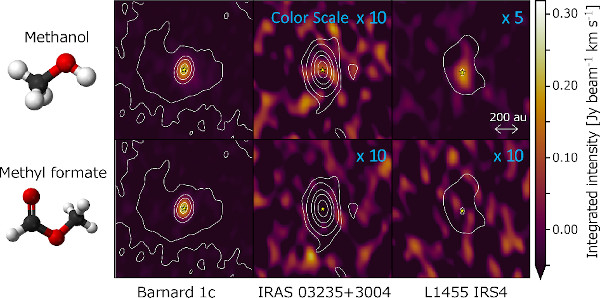
Distribution of molecular gas around some observed protostars in the Perseus Molecular Cloud

An article published in “The Astrophysical Journal” reports a study of organic molecules detected in 50 regions of protoplanetary disk formation in the Perseus Molecular Cloud. A team of researchers coordinated by the RIKEN Cluster for Pioneering Research used the ALMA radio telescope to detect the various molecules present in that molecular cloud, discovering that the distribution of complex organic molecules varies greatly in different areas. The composition was similar in young protoplanetary disks.

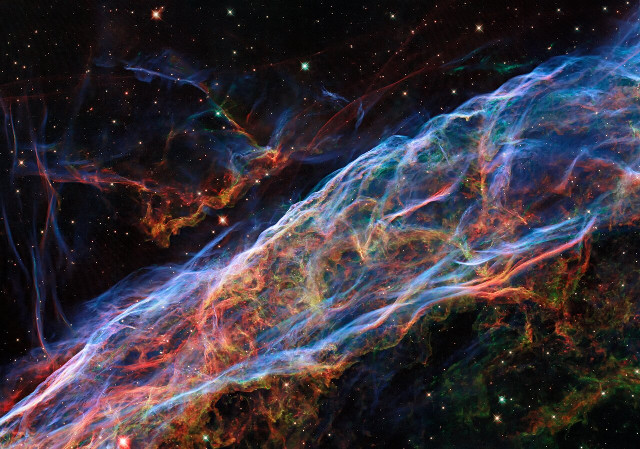
A part of the Veil Nebula (Image ESA/Hubble & NASA, Z. Levay)

A photo of part of the Veil Nebula captured by the Hubble Space Telescope offers a new view of these supernova remnants after applying new processing techniques. The Veil Nebula has already been at the center of observations, analysis, and processing of the images obtained because those remnants form a vast diffuse nebula that is made up of different parts cataloged with different designations and known by different names. This nebula in turn is only the visible part of the Cygnus Loop, as these supernova remnants must be observed in a wider range of the electromagnetic spectrum to be fully detected.