Stars

The SU Aurigae system (Image ESO/Ginski et al.)

An article published in “The Astrophysical Journal Letters” reports a research on the very young star SU Aurigae, or simply SU Aur, and on the protoplanetary disk around it. A team of researchers used new observations conducted with the SPHERE instrument on the VLT, combining them with old observations conducted with the NaCo instrument, also on the VLT, with the Hubble Space Telescope, and with the ALMA radio telescope to study the disk. It has a sort of tail of dust that comes from a nebula that is probably the result of a collision between the star and a cloud of gas and dust.

The remnants of the supernova SN 1987A seen by the NuSTAR space telescope and the Chandra X-ray Observatory together with an illustration of the pulsar powering a pulsar wind nebula

An article published in “The Astrophysical Journal” reports new evidence that a neutron star formed after the supernova SN 1987A. A team of researchers led by Emanuele Greco, Ph.D. student at the University of Palermo and associated with the Italian National Institute of Astrophysics used observations conducted with NASA’s Chandra X-ray Observatory and the NuSTAR space telescope to identify emissions that are compatible with a so-called pulsar wind nebula, an X-ray emitting nebula powered by a pulsar, which is a type of neutron star, inside it.

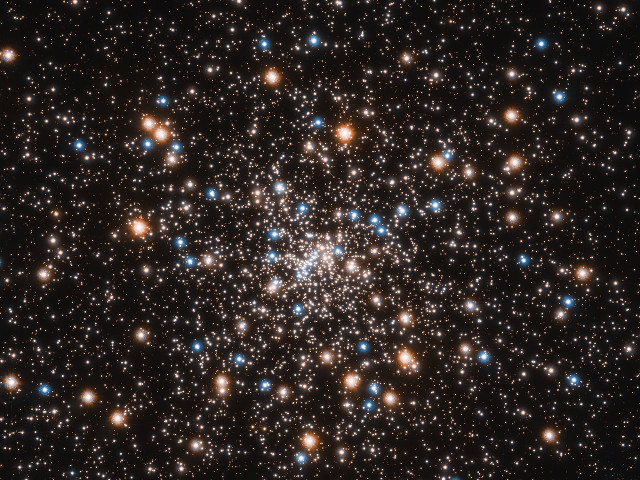
The globular cluster NGC 6397 seen by Hubble (Image NASA, ESA, and T. Brown and S. Casertano (STScI). Acknowledgement: NASA, ESA, and J. Anderson (STScI))

An article published in the journal “Astronomy & Astrophysics” reports evidence of the presence of a group of black holes in the globular cluster NGC 6397. Eduardo Vitral and Gary A. Mamon of the Institut d’Astrophysique de Paris (IAP) used observations conducted with the Hubble Space Telescope and the Gaia space probe to study the core of NGC 6397 expecting to find evidence of the presence of an intermediate-mass black hole that was a hidden mass, but the analyzes of the star movements within the cluster indicated the presence of various stellar-mass black holes.

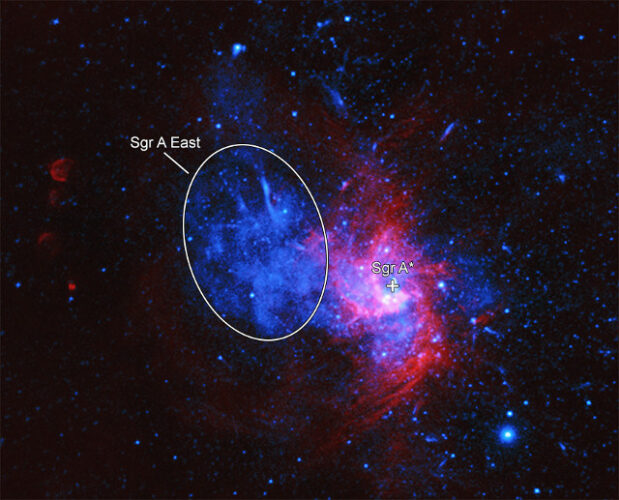
Sagittarius A East, or simply Sgr A East

An article to be published in “The Astrophysical Journal” reports a study on supernova remnants cataloged as Sagittarius A East, or simply Sgr A East. A team of researchers used observations conducted with NASA’s Chandra X-ray Observatory and the VLA radio telescope to study those remnants and concluded that they were generated by a rare type of supernova, the type Iax. The results can help astronomers understand the different ways a white dwarf can explode.

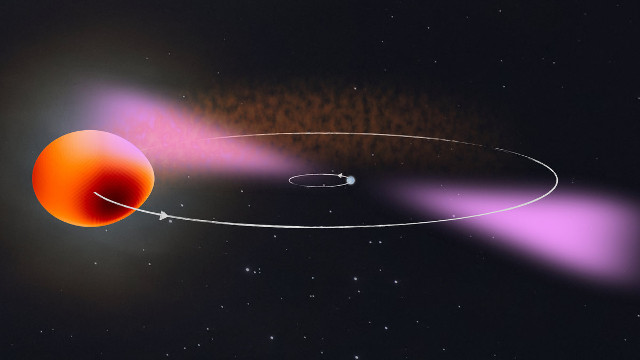
Artist's concet of the pulsar PSR J2039-5617 and its companion (Image Knispel/Clark/Max Planck Institute for Gravitational Physics/NASA GSFC)

Two articles published in the journal “Monthly Notices of the Royal Astronomical Society” report different aspects of the study that led to the identification of the rare characteristics of a gamma-ray source that turned out to be a pulsar, cataloged as PSR J2039-5617. Two teams with various researchers in common used data collected by the Fermi Space Telescope and other instruments, and relied on the help of citizen scientists participating in the Einstein@Home project to study the pulsar. It’s a rare type of pulsar because it belongs to the millisecond class and also to the so-called redback class, which has a red dwarf as a companion.