Stars

Artistic representation of an extreme horizontal branch star with a giant star spot

An article published in the journal “Nature Astronomy” reports a study on stars of a particular type since they’re much smaller than the Sun but much hotter and therefore blue. A team of researchers led by Yazan Al Momany of the Italian National Institute of Astrophysics, Padua, used various instruments on ESO’s Very Large Telescope (VLT) and NTT (New Technology Telescope) in Chile to study stars of that type discovering the equivalent of sunspots but even three thousand times larger in size. In some of these spots, flares have been observed that are millions of times more intense than the Sun’s which indicate the presence of very intense magnetic fields.

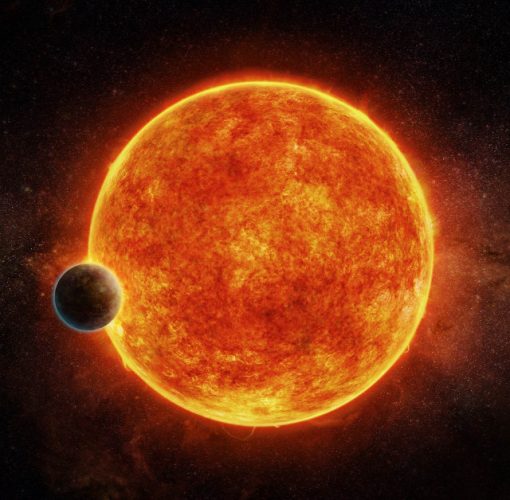
Artist's concept of a super-Earth with its star behind it (Image courtesy M. Weiss/CfA)

An article accepted for publication in the journal “Astronomy & Astrophysics” reports the discovery of a super-Earth in the system of HD 164922, a star that’s slightly smaller and slightly less massive than the Sun. A team of researchers led by Serena Benatti of the Italian National Institute for Astrophysics, Palermo, used the HARPS-N spectrograph installed on the Galileo Telescope, on the Canary Islands, to collect the data which, together with others previously collected with other instruments, allowed to discover the exoplanet designated as HD 164922d. The discoveries of exoplanets are increasingly made thanks to software that performs an automatic analysis of data collected by various telescopes, but in this case it’s the prize for the tenacity of astronomers who put together the data of years of observations conducted with various instruments.

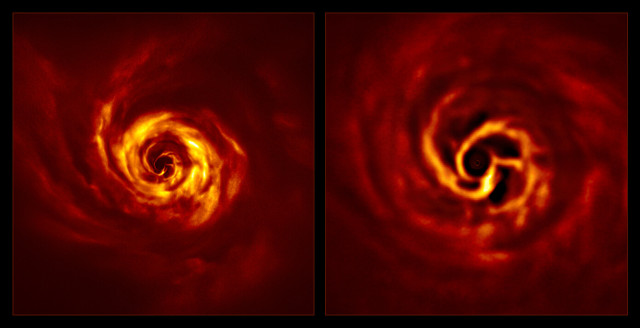
The AB Aurigae system seen by SPHERE

An article published in the journal “Astronomy & Astrophysics” reports evidence of the existence of a planet in formation in the protoplanetary disk surrounding the young star AB Aurigae. A team of researchers led by Anthony Boccaletti, of the Observatoire de Paris, PSL University, France, used the SPHERE instrument mounted on ESO’s VLT in Chile to find traces of what could be a planet. SPHERE takes real photos of the objects, so if the discovery was confirmed it would be the first direct evidence of a planet seen while it’s forming.

Artist's concept of the TRAPPIST-1 system (Image courtesy NAOJ)

An article published in “The Astrophysical Journal Letters” reports a study on the alignment of the ultra-cool dwarf star TRAPPIST-1 with its system’s 7 planets. A team of researchers led by Teruyuki Hirano of the Tokyo Institute of Technology used the Subaru telescope on Mount Mauna Kea, Hawaii, to observe that system not finding a significant misalignment of the planets with respect to their star. The astronomers who conducted the study warn that the measurements’ accuracy is not enough to completely rule out a small misalignment, but the result is significant in the study of the evolution of very small stars’ planetary systems.

Artist's concept of the HR 6819 system

An article published in the journal “Astronomy & Astrophysics” reports the discovery of a black hole in a triple system known as HR 6819. A team of researchers led by ESO’s Thomas Rivinius used the FEROS spectrograph on the MPG/ESO 2.2 meter telescope at La Silla to examine that system in a study on binary systems, surprisingly discovering the presence of a third object identified as a black hole. It’s the closest black hole to the solar system, but according to the researchers it could be the tip of the iceberg, and there could be many others like that, as predicted by theoretical models.