Stars

Slowing of the solar wind in the outer solar system

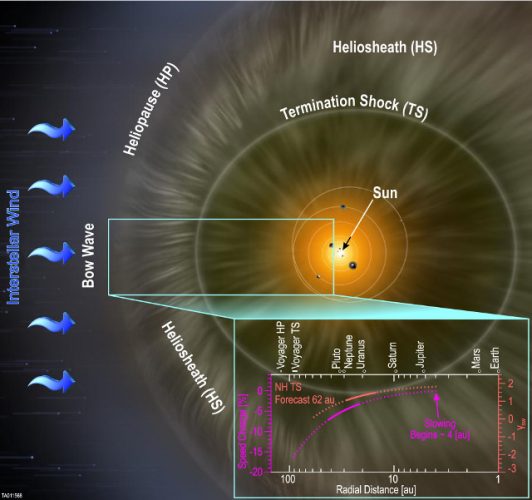
An article published in “The Astrophysical Journal” reports a study on changes in the solar wind in the outer region of the heliosphere, the bubble in which the influence of the Sun is felt. A team of researchers from the Southwest Research Institute led by Dr. Heather Elliott used measurements collected by NASA’s New Horizons space probe’s Solar Wind Around Pluto (SWAP) instrument to compare the speed of the solar wind at distances from the Sun between 1 and 3 times that of the Earth from the Sun and at distances between 21 and 43 times that distance reveals a slowdown between 5% and 7% at distances between 30 and 43 times that of the Earth from the Sun.

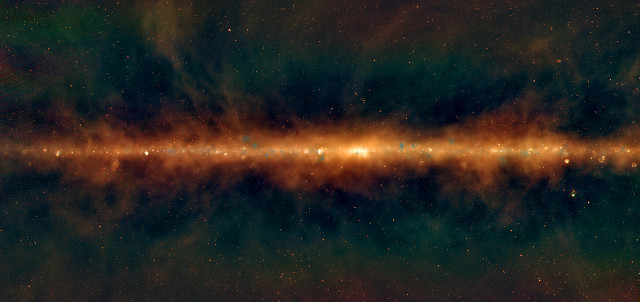
The center of the Milky Way seen in detail by the MWA radio telescope

Three articles published in the journal “Publications of the Astronomical Society of Australia (PASA)” report some results of the GaLactic and Extragalactic All-sky MWA (GLEAM) survey. A team of researchers created some images obtained thanks to the Murchison Widefield Array (MWA) radio telescope showing the center of the Milky Way. Thanks to the low-frequency radio emissions detected, it was possible to generate an image that reproduces both the larger structures and the details. This means that it was possible to obtain an overall image and images of individual objects such as 27 supernova remnants.

An investigation on multiple star systems shows that many of them host planets

An article published in the journal “Monthly Notices of the Royal Astronomical Society” reports an analysis of data collected by ESA’s Gaia space probe in search for exoplanets in multiple systems. Dr. Markus Mugrauer of the University of Jena, Germany, examined over 1,300 stars hosting exoplanets in a radius of about 1,600 light years from Earth to determine which of them had one or even more companions. The result is that over 200 of them are multiple systems, in one case even a quadruple one, in which the companions are above all red dwarfs but in eight cases there’s a white dwarf as a companion. This is the confirmation that multiple systems with exoplanets are not an exception and that exoplanets can survive the death of one of the stars.

A possible low-mass black hole discovered

An article published in the journal “Science” reports the discovery of what could be the lowest-mass known black hole, perhaps even the first of a new class of black holes. A team of researchers led by Professor Todd Thompson of Ohio State University used data from APOGEE (Apache Point Observatory Galactic Evolution Experiment) to discover a binary system that includes an invisible object that could be a black hole. If instead it were a neutron star it would be by far the most massive known, far beyond the theoretical highest limit before the collapse of such an object into a black hole.

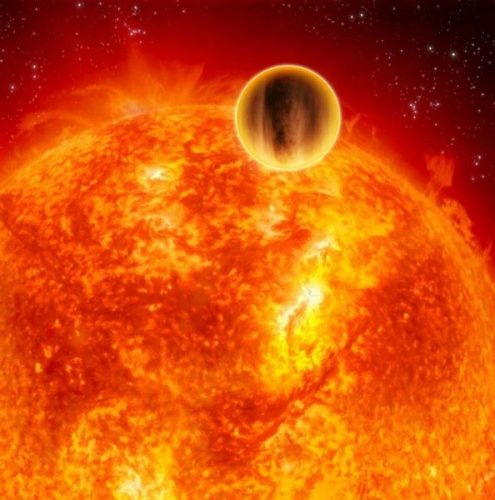
Artist's concept of exoplanet near its star (Image ESA)

An article published in “The Astrophysical Journal” reports the study of exoplanets that orbit two red giant stars: HD 212771 and HD 203949. A team of researchers led by Tiago Campante of the Instituto de Astrofísica and Ciências do Espaço (IA) of the University of Lisbon, Portugal, applied the astrosismology technique to observations conducted with NASA’s TESS space telescope. The result was surprising in the case of the HD 203949 system because the planet wasn’t swallowed by the star during its expansion even though it orbited very close to it.