
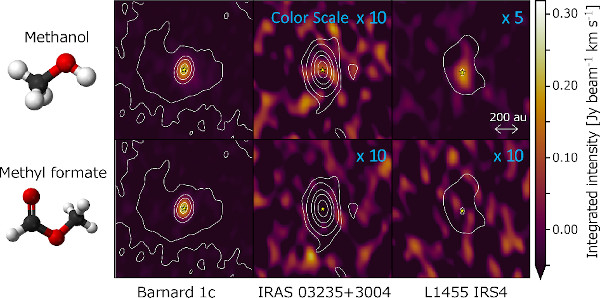
An article published in “The Astrophysical Journal” reports a study of organic molecules detected in 50 regions of protoplanetary disk formation in the Perseus Molecular Cloud. A team of researchers coordinated by the RIKEN Cluster for Pioneering Research used the ALMA radio telescope to detect the various molecules present in that molecular cloud, discovering that the distribution of complex organic molecules varies greatly in different areas. The composition was similar in young protoplanetary disks.
The star-forming region known as the Perseus Molecular Cloud is a few hundred light-years away from Earth, making it ideal for studying the processes that occur during the formation of a star and during the evolution of protoplanetary disks that normally form around protostars. Among the important objects of study in recent years are the organic molecules that form in protoplanetary disks, which could contribute to the birth of life on new planets where conditions are suitable.
The ALMA (Atacama Large Millimeter/submillimeter Array) radio telescope, inaugurated in March 2013, has the power and sensitivity to detect the chemical signatures left in the electromagnetic emissions by the various molecules present in the area under study. In this case, those are the organic molecules that are formed in the Perseus Molecular Cloud. We now know that those molecules are common in forming star systems. One of the questions concerned their distribution within a single molecular cloud, and this study showed that in 50 star-forming regions where there are protoplanetary disks there’s a different distribution of complex organic molecules.
It took three years of observations and analysis of the emissions detected to obtain the desired data but the results are really interesting. The researchers observed the presence of methanol and acetonitrile along with two larger molecules, methyl formate, and dimethyl ether. The image (Courtesy Yang et al. (2021)) shows the distribution of molecular gas around some observed protostars: the colors indicate the intensity of the emissions linked to the molecules while the contours show the thermal emissions from dust.
The researchers found considerable variability in the abundance of methanol and acetonitrile while the ratio in the abundance of the two molecules is strikingly similar. This suggests that there’s a mechanism that produces both molecules, an important clue to how they form in space. Another discovery is that methyl formate and dimethyl ether tend to be present in higher amounts than methanol in the densest regions of the molecular cloud.
This study offers new insights into the formation of organic molecules, including complex ones, in star systems in formation. This leads to questions about what happened during the early stages of the solar system’s history. The history of organic molecules in space crosses paths with that of their arrival on Earth thanks to comets, which helped to create the environment in which the first life forms emerged. It’s a history that may have taken place on other planets and could one day take place on new planets now forming in the Perseus Molecular Cloud.
