Telescopes

Mars seen on the left in a NASA image based on data from the Mars Orbiter Laser Altimeter (MOLA) and on the right by the Webb Space Telescope's Near-Infrared Camera instrument (NIRCam) at two different infrared wavelengths

The first images of Mars captured by the James Webb Space Telescope on September 5, 2022, offer views of the planet at different infrared wavelengths and some spectroscopies. Webb is in a position where it can see part of the sunlit side of Mars and can provide images and spectra to help complete the detections of space probes, rovers, and other telescopes. The red planet is very close and very bright compared to the normal targets of Webb’s observations, so the exposures used were very short to avoid causing problems to the instruments.

The Orion Nebula's inner region seen by the James Webb Space Telescope (Image courtesy NASA, ESA, CSA, PDRs4All ERS Team; image processing Salomé Fuenmayor)

New images of the Orion Nebula’s inner region captured by the James Webb Space Telescope show new details of a stellar nursery that has already been studied many over time but continues to reveal new objects every time a new instrument is used to study it. These observations were conducted as part of Webb’s Early Release Science (ERS) program and obtained on September 11, so at the moment, no scientific articles are available on the subject yet but in the future, we can expect an analysis of the collected data and some new discoveries about the processes of star and planet formation.

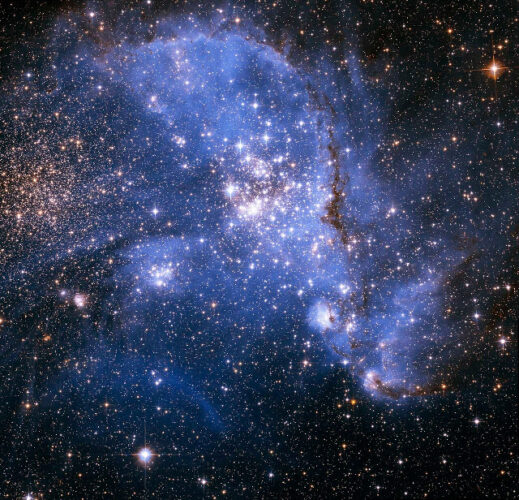
The cluster NGC 346 seen by Hubble (Image NASA, ESA, A. James (STScI))

Two articles published in “The Astrophysical Journal” report different aspects of a study on NGC 346, an open cluster of stars in the Small Magellanic Cloud, one of the satellite dwarf galaxies of the Milky Way. Two teams of researchers who share their respective leaders, Elena Sabbi of the Space Telescope Science Institute and Peter Zeidler of the AURA/STScI for ESA, used observations conducted with the Hubble Space Telescope and the VLT. They examined the spiraling motion of the cluster’s stars within it, a motion that appears to favor star formation.

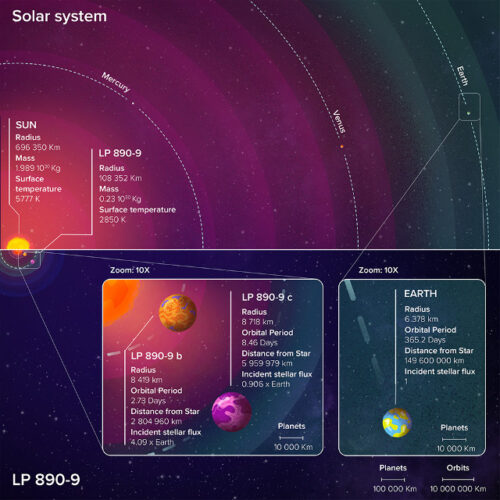
A comparison between the LP 890-9 system and the inner solar system with the characteristics of the stars and their rocky planets

An article published in the journal “Astronomy & Astrophysics” reports the identification of two super-Earths in the system of LP 890-9, a star that is tiny even by red dwarf standards. A team of researchers led by astrophysicist Laetitia Delrez of the Belgian University of Liège examined a candidate identified by the TESS space telescope using the SPECULOOS project Southern Observatory to monitor that system confirming the existence of the exoplanet cataloged LP 890-9b. SPECULOOS found a second exoplanet by observing further transits which was cataloged as LP 890-9c and is in ​its system’s habitable zone. Only TRAPPIST-1 is a smaller star than LP 890-9 among the ones known to have planets.

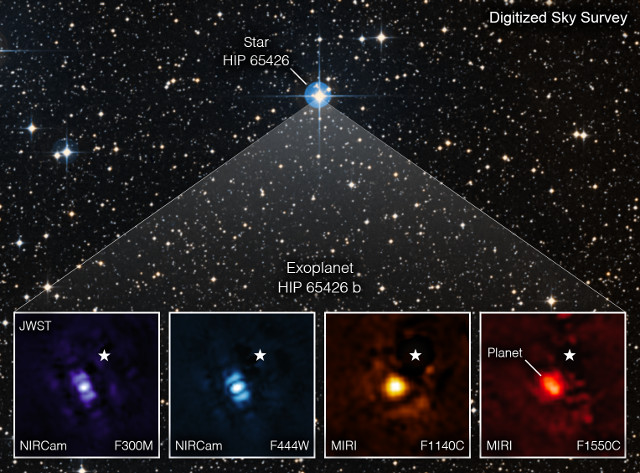
The star HIP 65426 in a Digitalized Sky Survey image and at the bottom, the exoplanet HIP 65426 b seen at different infrared frequencies by the James Webb space telescope's NIRCam and MIRI instruments

An article submitted for peer-review reports the results of the first direct observation of an exoplanet, a super-Jupiter cataloged as HIP 65426 b, by the James Webb Space Telescope. A large international collaboration led by Sasha Hinkley, associate professor of physics and astronomy at the British University of Exeter, conducted observations of this gas giant as part of Webb’s Early Release Science (ERS) program. There are no revolutionary results but the new space telescope observed new details of an already known exoplanet confirming that it can be a valuable instrument to study exoplanets.