Telescopes

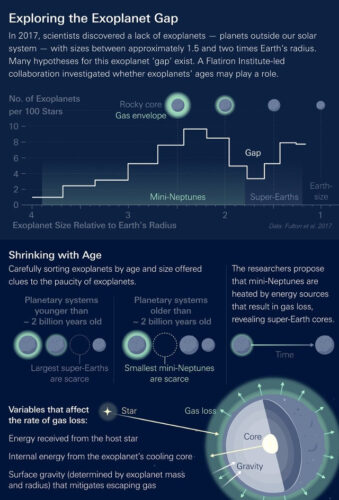
An infographic that illustrates the statistics of exoplanets with the radius gap and the possible mechanisms that make mini-Neptunes shrink until they turn into super-Earths

An article published in “The Astronomical Journal” reports a study on the scarcity of exoplanets with a radius between 1.5 and 2 times the Earth’s. A team of researchers led by Trevor David of the Flatiron Institute in New York studied what is commonly referred to as a radius gap using data collected by NASA’s Kepler Space Telescope. By dividing the exoplanets studied between those older than 2 billion years and those younger, the exam offers new information confirming the theory that sub-Neptunes can lose most of their atmosphere and transform into super-Earths even after billions of years.

Schematical representation of the expansion of the Universe over the course of its history (Image courtesy NAOJ)

An article published in “The Astrophysical Journal” reports a calculation of the expansion velocity of the universe based on type Ia supernovae. A team of researchers led by Professor Maria Giovanna Dainotti used a sample of 1048 supernovae that have very different distances from Earth, dividing them into groups based on their distance. The values ​​obtained are decreasing starting from the nearest supernovae, and those obtained using the most distant supernovae approach the value based on the cosmic microwave background radiation.

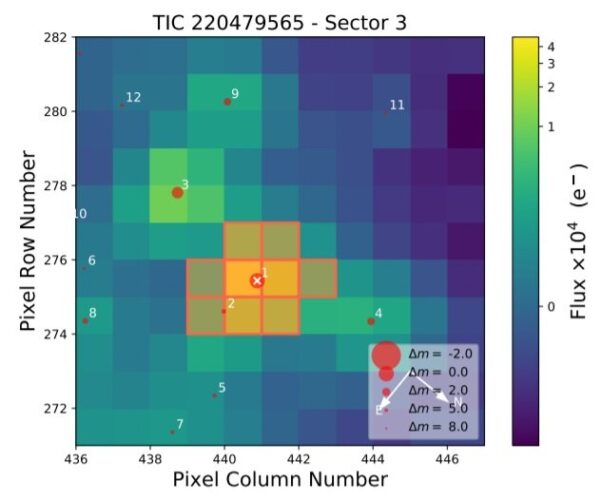
TOI-269 seen by TESS

An article accepted for publication in the journal “Astronomy & Astrophysics” reports the confirmation by a team of researchers led by Marion Cointepas of the exoplanet TOI-269 b, a sub-Neptune orbiting a red dwarf discovered thanks to NASA’s TESS space telescope. It’s a warm Sub-Neptune because its year only lasts 3.7 Earth days, as it’s very close to its star. It’s not the first case of that type, but this is interesting because estimates of its characteristics indicate that it’s close to the boundaries between sub-Neptunes and super-Earths. The loss of the atmosphere with the transformation from sub-Neptune to super-Earth is a case studied only in theory and TOI-269 b could provide useful information to understand this process.

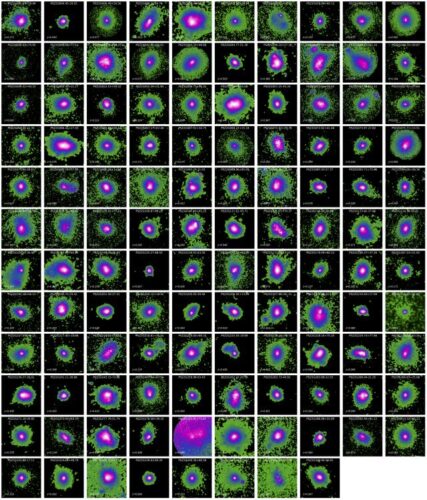
The 118 galaxy clusters of the CHEX-MATE program

An article published in the journal “Astronomy & Astrophysics” reports an overview of the CHEX-MATE (Cluster HEritage project with XMM-Newton – Mass Assembly and Thermodynamics at the Endpoint of structure formation) program’s work, which includes a study of a sample of 118 galaxy clusters carefully selected. The CHEX-MATE Collaboration observed those galaxy clusters with ESA’s XMM-Newton space telescope in a survey lasting a total of 3 million seconds.

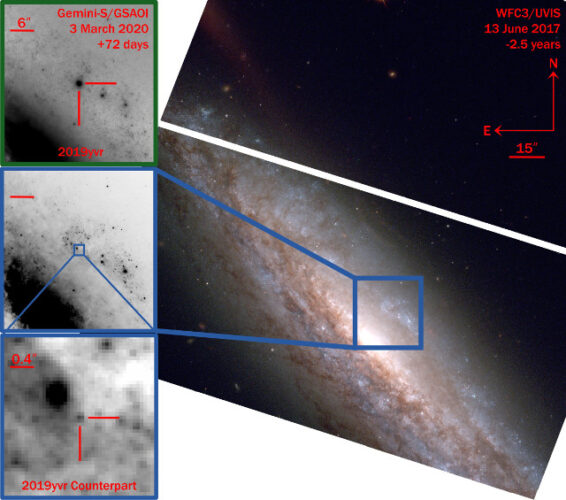
Views of the the supernova 2019yvr and the probable progenitor star

An article published in the journal “Monthly Notices of the Royal Astronomical Society” reports a study on the type Ib supernova cataloged as 2019yvr and on its progenitor star, which is enveloped by hydrogen layers that are unexpected in that type of supernova. A team of researchers led by Charles Kilpatrick, a postdoctoral fellow at Northwestern University, used observations made with the Hubble Space Telescope about 2.6 years before the supernova to examine the progenitor star, a yellow supergiant with characteristics very different from those they generally generate a type Ib supernova. One possibility regarding the hydrogen missing in the supernova is that it was snatched from this star by a companion.