Cosmology

The likely galaxies where the origins of fast radio bursts cataloged as FRB 190714 (top) and FRB 180924 (bottom) was located

An article to be published in “The Astrophysical Journal” reports the location of the origin of eight fast radio bursts (FRBs) detected between 2017 and 2020. A team of researchers coordinated by the University of California at Santa Cruz used the Hubble Space Telescope to accomplish this task by applying a method already used to pinpoint the origin of other cosmic phenomena such as supernovae and gamma-ray bursts. This result offers new information on an extremely energetic phenomenon such as fast radio bursts, which emit an amount of energy in a millisecond comparable to the amount the Sun emits in a year. The results of this study are compatible with the theory that links them to magnetars.

Schematical representation of the expansion of the Universe over the course of its history (Image courtesy NAOJ)

An article published in “The Astrophysical Journal” reports a calculation of the expansion velocity of the universe based on type Ia supernovae. A team of researchers led by Professor Maria Giovanna Dainotti used a sample of 1048 supernovae that have very different distances from Earth, dividing them into groups based on their distance. The values ​​obtained are decreasing starting from the nearest supernovae, and those obtained using the most distant supernovae approach the value based on the cosmic microwave background radiation.

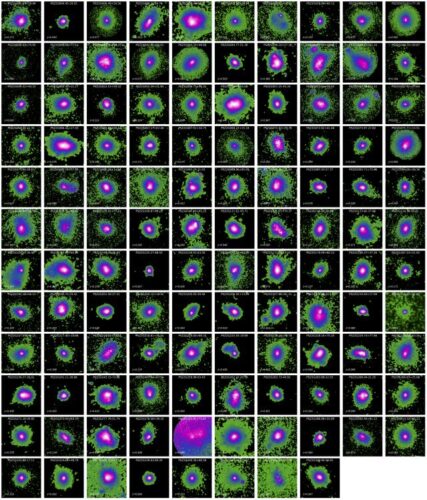
The 118 galaxy clusters of the CHEX-MATE program

An article published in the journal “Astronomy & Astrophysics” reports an overview of the CHEX-MATE (Cluster HEritage project with XMM-Newton – Mass Assembly and Thermodynamics at the Endpoint of structure formation) program’s work, which includes a study of a sample of 118 galaxy clusters carefully selected. The CHEX-MATE Collaboration observed those galaxy clusters with ESA’s XMM-Newton space telescope in a survey lasting a total of 3 million seconds.

A NASA diagram of the PWS instrument's location and the antenna in common with the PRA instrument

An article published in the journal “Nature Astronomy” reports a study on the faint interstellar plasma waves detected by NASA’s Voyager 1 space probe. A team of researchers led by Stella Koch Ocker of Cornell University used a series of detections conducted by Voyager 1 while traveling a total distance that is about ten times the average distance of the Earth from the Sun which gives an idea of ​​the characteristics of the interstellar plasma when it’s not altered by events related to solar activity.

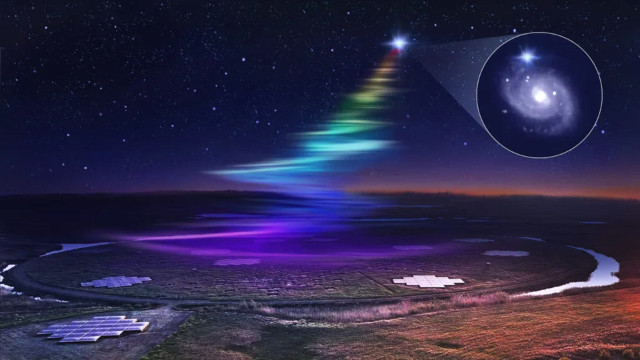
Artistic concept of the LOFAR radio telescope and fast radio burst FRB 20180916B (Image courtesy D. Futselaar / S.P. Tendulkar / ASTRON)

Two articles, one published in “The Astrophysical Journal Letters” and one published in “Nature Astronomy”, report various aspects of a research on the fast radio burst FRB 20180916B, whose emissions include the lowest frequencies at which such an event has been detected so far. Two teams of researchers with various members in common used detections obtained with the LOFAR radio telescope and the European VLBI network to study this fast radio burst that is repeating with a periodicity of just over 16 days. Its origin has been pinpointed in a small region around a neutron star.