Stars

Schematical representation of the expansion of the Universe over the course of its history (Image courtesy NAOJ)

An article published in “The Astrophysical Journal” reports a calculation of the expansion velocity of the universe based on type Ia supernovae. A team of researchers led by Professor Maria Giovanna Dainotti used a sample of 1048 supernovae that have very different distances from Earth, dividing them into groups based on their distance. The values ​​obtained are decreasing starting from the nearest supernovae, and those obtained using the most distant supernovae approach the value based on the cosmic microwave background radiation.

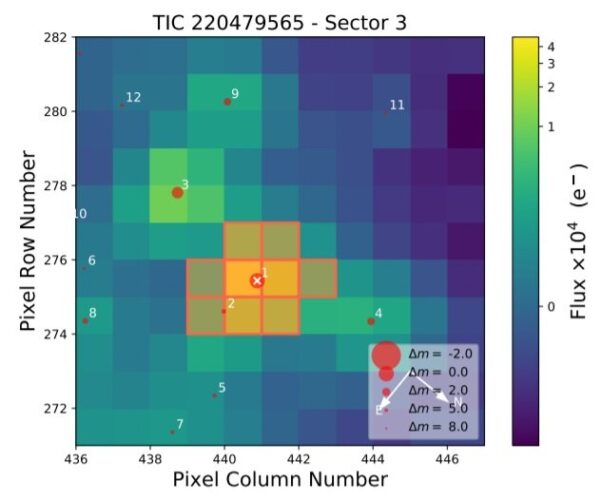
TOI-269 seen by TESS

An article accepted for publication in the journal “Astronomy & Astrophysics” reports the confirmation by a team of researchers led by Marion Cointepas of the exoplanet TOI-269 b, a sub-Neptune orbiting a red dwarf discovered thanks to NASA’s TESS space telescope. It’s a warm Sub-Neptune because its year only lasts 3.7 Earth days, as it’s very close to its star. It’s not the first case of that type, but this is interesting because estimates of its characteristics indicate that it’s close to the boundaries between sub-Neptunes and super-Earths. The loss of the atmosphere with the transformation from sub-Neptune to super-Earth is a case studied only in theory and TOI-269 b could provide useful information to understand this process.

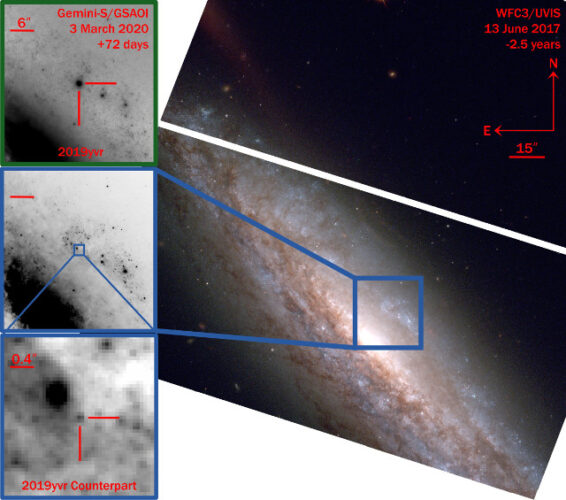
Views of the the supernova 2019yvr and the probable progenitor star

An article published in the journal “Monthly Notices of the Royal Astronomical Society” reports a study on the type Ib supernova cataloged as 2019yvr and on its progenitor star, which is enveloped by hydrogen layers that are unexpected in that type of supernova. A team of researchers led by Charles Kilpatrick, a postdoctoral fellow at Northwestern University, used observations made with the Hubble Space Telescope about 2.6 years before the supernova to examine the progenitor star, a yellow supergiant with characteristics very different from those they generally generate a type Ib supernova. One possibility regarding the hydrogen missing in the supernova is that it was snatched from this star by a companion.

Radio-infrared overlay of the W49A molecular cloud. (Image DePree, et al.; Sophia Dagnello, NRAO/AUI/NSF; Spitzer/NASA)

An article published in “The Astronomical Journal” reports the study of a nursery of stars in the great molecular cloud cataloged as W49A. A team of astronomers led by Professor Christopher De Pree of Agnes Scott College compared new observations conducted with the VLA (Very Large Array) at infrareds and radio waves of ​​W49A’s central area with observations conducted with the same radio telescope between 1994 and 1995. The result is the identification of new activities with supersonic gas movements in three regions and a high-speed jet in one region.

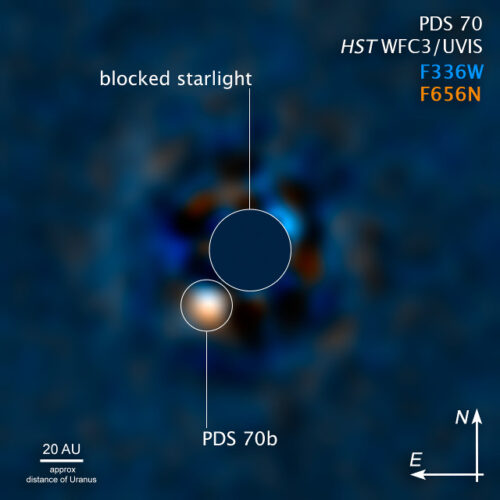
The PDS 70 system seen by Hubble

An article published in “The Astrophysical Journal” reports the first estimates of the growth of a young gas giant exoplanet. A team of researchers used observations conducted with the Hubble Space Telescope of the exoplanet PDS 70b exploiting its sensitivity to ultraviolets emitted by hot gas that gets swallowed by the young giant. This study opens the door to new possibilities for estimating the growth of gas giant planets.