
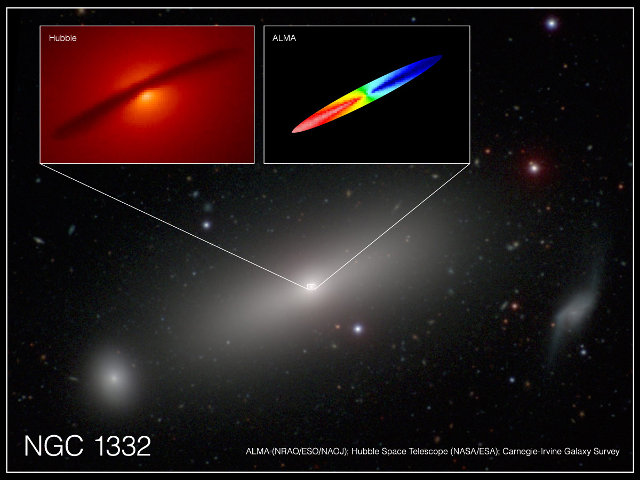
An article published in the journal “Astrophysical Journal Letters” describes the most precise measurement so far carried out of the mass of a supermassive black hole. A team led by astronomer Aaron Barth of the University of California, Irvine (UCI) used the ALMA radio telescope to examine the supermassive black hole at the center of the galaxy NGC 1332.
The ALMA (Atacama Large Millimeter/submillimeter Array) radio telescope was inaugurated in March 2013 and with its array of 66 antennas can detect millimeter and submillimetre wavelengths with unprecedented sensitivity. This research on the supermassive black hole in the galaxy NGC 1332 was conducted in two phases: an initial observation in September 2014, which revealed the cold gas disk around the black hole, and a second one in September 2015 in high-resolution mode that allowed to accurately map the rotation of the disk.
Thanks to ALMA, it was possible to observed at sufficiently small scales the cold gas disk around the supermassive black hole in NGC 1332, a large elliptical galaxy about 73 million light years from Earth. This sensitivity allowed to clearly distinguish the enormous gravitational influence of the black hole on the disk’s rotation speed.
The problem was to distinguish the gravitational influence of the supermassive black hole from that of stars, interstellar gas clouds and dark matter. For this reason, the estimate of the mass of the black hole at the center of NGC 1332 galaxy ranged from 500 million to 1.5 billion solar masses. The observations with ALMA have a higher resolution than any other observation made in the past.
Many measurements made with optical telescopes such as the Hubble Space Telescope focused on the emissions from the hot-gases that orbit close to the supermassive black hole. However, those are ionized gases that tend to be much more turbulent than the cold gases. The consequence is a lower accuracy in measurements.
The ALMA use allowed to avoid those problems because it can detect the cooler gas emissions, in this case in particular of carbon monoxide. Near the center of the disk around the supermassive black hole in the galaxy NGC 1332, the cold gases travel at speeds above 500 km/s (about 310 miles per second). This allowed to make an estimate of its mass based on its gravitational influence of 660 million solar masses more or less 10%.
This supermassive black hole is about 150 times more massive than Sagittarius A*, the one at the center of the Milky Way, though others much more massive were found. The use of the ALMA radio telescope for this kind of observations can also be applied to other galaxies. More accurate measurement of the mass of supermassive black holes will allow to better understand their influence on the evolution of the galaxies that host them.
