The Dragon cargo spacecraft departing the International Space Station to end its CRS-33 mission (Image NASA+)

A little while ago, SpaceX’s Dragon spacecraft ended its CRS-33 (Cargo Resupply Service 33) mission for NASA splashing down smoothly off the coast of California. The Dragon left the International Space Station about 12 hours earlier. The Dragon spacecraft had reached the International Space Station on August 25, 2025. For SpaceX, it was the 50th mission to the Station, including the Dragon cargo and Crew Dragon crewed missions.

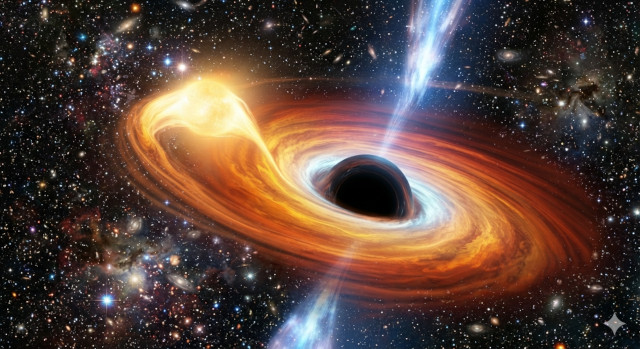
An illustration of the emission detected from the galaxy HATLAS J142935.3–002836

An article accepted for publication in the journal “Monthly Notices of the Royal Astronomical Society Letters” reports the detection of a megamaser generated by HATLAS J142935.3–002836, a galaxy undergoing considerable activity due to a galaxy merger that also led to an intense star formation. A team of researchers led by the University of Pretoria, South Africa, used the MeerKAT radio telescope to detect the maser emissions. The strength of its emissions is so high that the researchers called it a gigamaser, but certain detections are only possible thanks to a gravitational lensing phenomenon. This still makes it the brightest and most distant astronomical maser known.

Views of the Crew Dragon Freedom spacecraft docking with the International Space Station in its Crew-12 mission (Image NASA+)

A few hours ago, SpaceX’s Crew Dragon Freedom spacecraft docked with the Harmony module of the International Space Station, completing the first part of its Crew-12 or SpaceX Crew-12 mission that began with its launch about 34 hours earlier. After checking that the pressure gets properly balanced, the hatch will be opened to allow Andrey Fedyaev, Jack Hathaway, Jessica Meir, and Sophie Adenot to enter the Station and start their mission.

The Crew-12 mission crew: Andrey Fedyaev, Jack Hathaway, Jessica Meir, and Sophie Adenot.

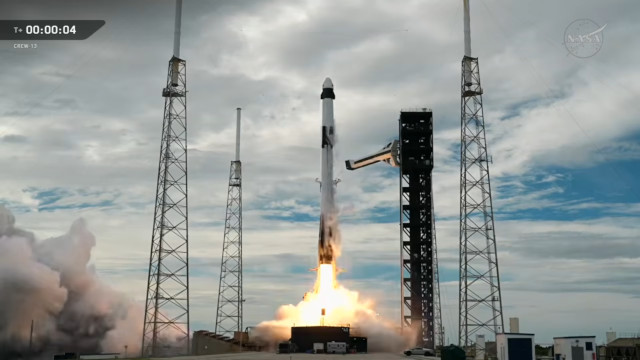
A little while ago, SpaceX’s Crew Dragon Freedom spacecraft blasted off atop a Falcon 9 rocket from the Kennedy Space Center in its Crew-12 or SpaceX Crew-12 mission. After almost exactly ten minutes, it successfully separated from the rocket’s last stage and went en route to carry out its mission. This is the 12th crewed mission of the Crew Dragon spacecraft within the normal rotation of the International Space Station crew.

The Menghzou spacecraft splashes down (Photo courtesy of Wang Heng/Xinhua)

Yesterday, the Chinese Menghzou spacecraft, launched on the Long March 10 rocket’s first stage from the Wenchang launch site, completed a suborbital flight test. The rocket conducted its own test, lasting nearly 8 minutes, with a controlled splashdown, as part of the development of a reusable launch system. At the end of the test, the Menghzou splashed down as well, but in its case, it was also recovered, as the capsule is designed to carry taikonauts and is also reusable. These were important tests because their success represents a step forward toward Chinese crewed Moon missions.