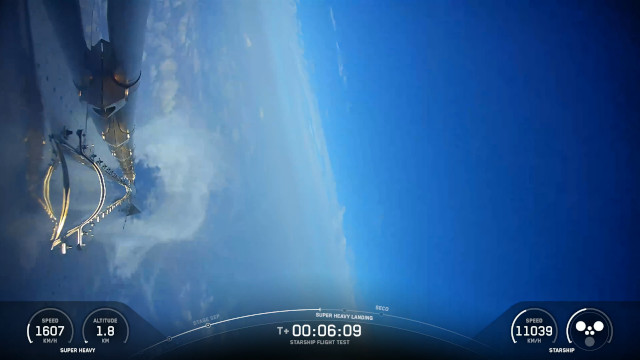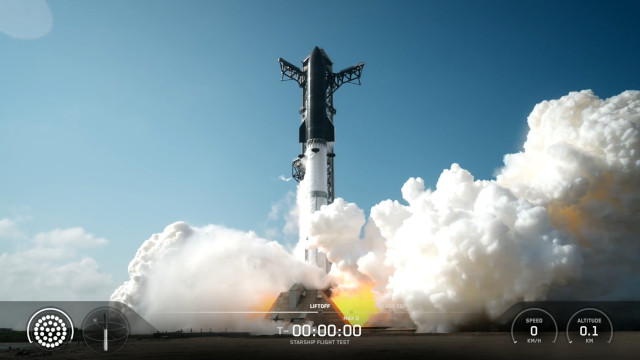
It was the afternoon in the USA when SpaceX conducted a new flight test of its Super Heavy rocket and Starship prototypes, launched from its base in Boca Chica, Texas. This is the 12th test involving the entire system of Elon Musk’s company, which is supposed to revolutionize space travel with an unprecedented transport capacity and being totally reusable. They are advanced prototypes with the Super Heavy identified as Booster 19 and the Starship identified as Starship 39 or Ship39 or simply S39. It was the first test of the vehicles in their Block 3 version.
The 11th test, conducted on October 13, 2025, significantly restored optimism for a project that had suffered several delays due to various problems. Design work continued, developing the Block 3 version of Booster and Starship, with the vehicles featuring several engineering improvements. This also includes the Raptor 3 engines.
According to the initial plans, the 12th flight test was supposed to use the Super Heavy designated Booster 18, but it was damaged during a ground test conducted on November 21. The examinations of Booster 18 convinced the SpaceX team to scrap it in favor of Booster 19.
No recovery attempt was planned for the first test with the Block 3 vehicles. The trajectory was essentially the same as the previous tests, with the Super Heavy splashing down in the Gulf of Mexico and the Starship splashing down in the Indian Ocean.
Liftoff was a success, with all Raptor 3 engines on Super Heavy Booster 19 firing normally. However, after nearly two minutes, one of the engines unexpectedly shut down. Shortly thereafter, Starship 39 separated normally. Again, shortly thereafter, one of the spacecraft engines unexpectedly shut down.
Even in the most negative previous tests, the Super Heavy had performed best, including in controlled landings. However, Booster 19 suffered serious engine problems during the descent maneuvers, with only five engines firing, half of those required for a controlled splashdown.
The situation got even worse during the burns, and in the end, Booster 19 crashed into the surface of the Gulf of Mexico just over six minutes after liftoff because by the end of the maneuvers, only one of its engines had relit.
Starship 19 managed to continue its flight despite the failure of one of its engines. A re-light test of one of the engines was also scheduled in space, but it was decided not to conduct it because Starship’s trajectory wasn’t exactly as planned. However, it was possible to conduct the orbital launch test of 20 Starlink satellite simulators. There’s been much talk about these new vehicles for use in Moon missions as part of NASA’s Artemis program, but for SpaceX, their use in launching multiple satellites, such as Starlink satellites, in a single flight is also important.
Two of the Starlink satellite simulators were equipped with cameras. This allowed them to capture close-up images of Starship 19, covering various parts of the heat shield. These images are of interest to the audience and also to SpaceX engineers, who were able to observe what was happening to the heat shield and can study the images later.
Despite the engine failure, Starship 19 managed to complete most of the tasks planned for this test. Just over an hour and six minutes after liftoff, it splashed down in the Indian Ocean, using two engines instead of three for its descent maneuvers. The Starship also suffered a violent impact, and it exploded.
It was the first test of the Block 3 vehicles, so some problems were expected. The Raptor 3 engines appear to require some fine-tuning, given the problems encountered in both the Super Heavy and Starship. In essence, the 12th test is a mixed bag. In these cases, the date of a new test depends on the time required to resolve the problems encountered.