Black holes

Blogs about black holes

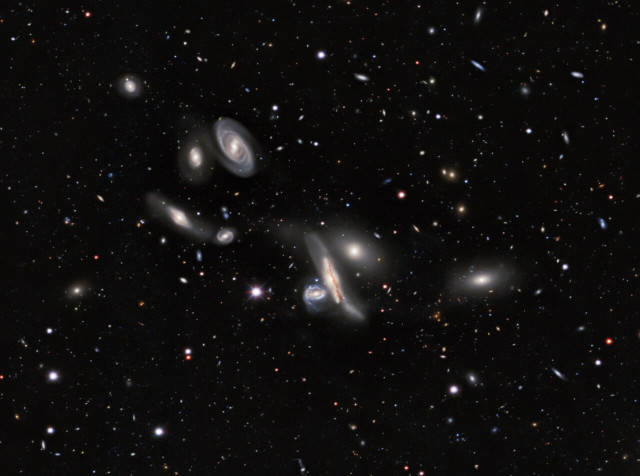
Some of the galaxies included in the DESI Legacy Imaging Surveys map (Image: DESI Legacy Imaging Surveys/LBNL/DOE & KPNO/CTIO/NOIRLab/NSF/AURA)

The DESI Legacy Imaging Surveys team has released the largest 2D map of the universe. Consisting of 5.6 trillion pixels, this map includes nearly 4 billion celestial objects, ranging from asteroids to galaxies, as well as other objects such as stars, black holes, and more. It’s a vast archive spanning approximately three-quarters of the sky, useful for astronomical studies requiring information at optical and near-infrared frequencies. This result isn’t the final one, as the map will be used to determine the distances to objects such as quasars to construct a new map, this time 3D.

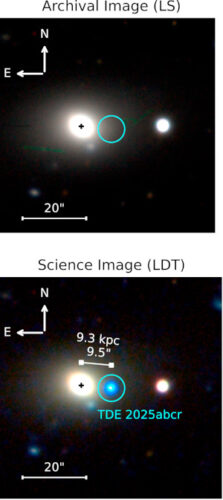
An archival image of the galaxy WISEA J014656.04-152214.7 and the location of the TDE 2025abcr event (above), as well as the same area imaged on December 14, 2025, with the tidal disruption event visible in the blue circle

An article published in “The Astrophysical Journal Letters” reports the discovery of a supermassive black hole on the outskirts of its host galaxy WISEA J014656.04-152214.7, approximately 30,000 light-years from its center. A team of researchers found its traces thanks to a so-called tidal disruption event cataloged as TDE 2025abcr. Detected for the first time by the Zwicky Transient Facility (ZTF), thanks in part to a new artificial intelligence algorithm, the event was confirmed and studied for months in various electromagnetic bands using various instruments. This discovery supports the theory that wandering supermassive black holes can exist very distant from the center of a galaxy, where they normally reside.

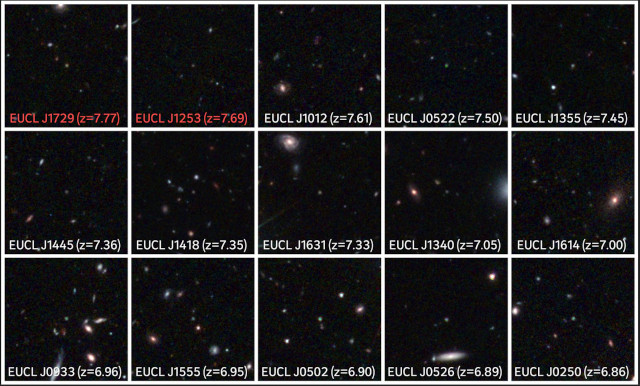
15 of the 31 discovered quasars. Each of them is visible as a dot at the center of its image. The two oldest quasars are shown in red.

An article published in the journal “Astronomy & Astrophysics” reports the discovery of 31 new primordial quasars, including the two oldest known so far. A team of researchers used observations conducted with ESA’s Euclid space telescope as part of the Euclid Wide Survey to find quasars we see as they were when the universe was no more than 800 million years old.

A combination of data collected with the ALMA radio telescope, shown in red, and the Chandra X-ray Observatory, shown in blue. Sagittarius A* is at the center.

An article published in “The Astrophysical Journal Letters” reports evidence of a cosmic wind emanating from Sagittarius A*, the supermassive black hole at the center of the Milky Way. Mark D. Gorski and Lena Murchikova of Northwestern University’s Center for Interdisciplinary Exploration and Research in Astrophysics used observations with the ALMA radio telescope and NASA’s Chandra X-ray Observatory to create a high-quality map of the cold carbon monoxide gas surrounding Sagittarius A*. The map shows a cone-shaped cavity where a hot, energetic wind blows and sweeps away the gas.

Abell 2744-QS01. The insets show zooms of three separate views of QS01 generated by gravitational lensing

Two articles, one published in the journal “Nature” and one in the “Monthly Notices of the Royal Astronomical Society”, report different aspects of a study of the supermassive black hole cataloged as Abell 2744-QSO1, or simply QSO1, indicating that it’s older than its host galaxy. A team of researchers used observations with the James Webb Space Telescope to study QSO1 and measured its mass at about 50 million times the Sun’s. This means it makes up at least two-thirds of the total mass of the galaxy, an anomaly that betrays its age and leaves open some possible hypotheses about its origin.