
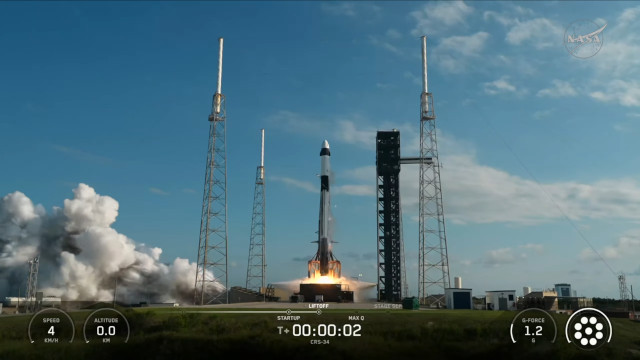
A few hours ago, the SpaceX Dragon 2 spacecraft blasted off atop a Falcon 9 rocket from Cape Canaveral in its CRS-34 (Cargo Resupply Service 34) mission, also referred to as SPX-34. After almost 12 minutes, it separated successfully from the rocket’s last stage and went en route. This is the 34th mission for the Dragon/Dragon 2 spacecraft to resupply the International Space Station with various cargoes and then return to Earth, again with various cargoes.
The Dragon 2 spacecraft’s cargo is about 2,949 kg (more than 6,500 lbs) between the pressurized and the non-pressurized sections. There are about 618 kg (about 1,363 lbs) of food and other supplies for the International Space Station crew, but most of the cargo consists of instruments, hardware, and various other materials needed for science experiments and research conducted aboard the Station.
The Dynamics during Spaceflight and in Simulated Microgravity (ODYSSEY) experiment aims to evaluate biofilm formation and the exchange of genetic material between two bacterial species in real microgravity and in a ground-based microgravity simulation chamber.
The Green Bone in Microgravity (Green Bone) experiment aims to grow human bone cells on a specially treated rattan fiber scaffold in microgravity. This simulates osteoporosis, and the results are useful for research into this medical condition.
Another medical experiment is the Spleen Activity in Space Anemia and Red Cell Kinetics (SPARK) experiment, which aims to study changes in the spleen and the degradation of red blood cells in space. Forms of anemia can develop in astronauts in space, and understanding the mechanisms is essential to protect crews on long-duration missions.
The Laplace experiment, on the other hand, is part of astronomical studies, as it studies the motions and collisions of dust particles in microgravity. Its goal is to deepen our understanding of particle motion in space and provide new insights into the early stages of planet formation from disks of gas and dust.
This Dragon 2 cargo spacecraft is on its 6th mission: this marks a new record for the use of this spacecraft in its cargo version for SpaceX, but this doesn’t make the news anymore. Its arrival at the station is scheduled for tomorrow: around 11.00 UTC, it will dock to the Station with an automated manoeuvre.
