
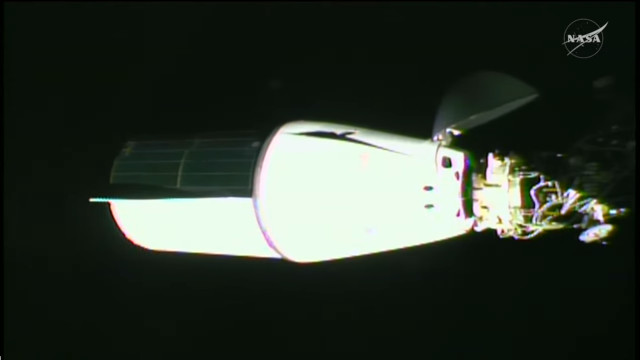
A little while ago, SpaceX’s Dragon 2 spacecraft docked with the International Space Station’s Harmony module completing the first part of its CRS-34 mission. Astronaut Jack Hathaway and his colleague Sophie Adenot monitored the operation but the cargo spacecraft, which blasted off about 37 hours earlier, completed the maneuvers automatically without any problem.
The Dragon spacecraft’s approach to the International Space Station follows a procedure that has become routine but remains long and delicate. The Station’s safety is the top priority, so every little step of the Dragon gets checked. Only if all goes well in the spacecraft’s position and velocity, they proceed with the next step, and in case of any problems, the process can be aborted at every step. The Dragon 2 carries out all the maneuvers automatically up to the docking, and the procedure can be interrupted until the last moment.
The second version of the Dragon cargo spacecraft can remain in space much longer than the first version, but resupply missions still almost always last a few weeks. The primary use of the Dragon cargo spacecraft after arriving at the International Space Station is as the only one capable of bringing cargoes back to Earth. The secondary use, tested in recent missions, is to re-orbit the Station using extra Draco engines with their own independent propulsion system. For these reasons, the length of Dragon cargo spacecraft missions depends on the needs of the Station.
After completing all the procedures to make the Dragon cargo spacecraft an appendage of the International Space Station, the hatch can be opened, and the cargo can begin unloading in priority order. For example, there’s a new power cable for the European Enhanced Exploration Exercise Device, used for the astronauts’ exercise system. There are also components for the recycling systems.
Among the new instruments transported, there’s STORIE (Storm Time O+ Ring Current Imaging Evolution), designed to study Earth’s magnetic field, its interactions with charged particles, and its changes over time. It will be installed outside the International Space Station using a robotic instrument.
