2016

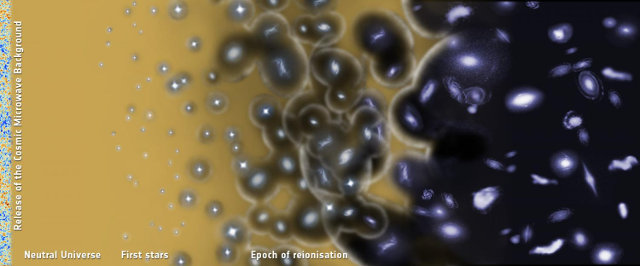
Artist's impression of a portion in the timeline of the Universe, around the epoch of reionization (Image ESA – C. Carreau)

Two articles published in the journal “Astronomy and Astrophysics” describe the latest updates regarding the analysis of the data collected by ESA’s Planck Surveyor space probe between 2009 and 2013. The latest results show that the first stars started forming about 700 million years after the Big Bang, about 150 million years later than earlier analyzes indicated.

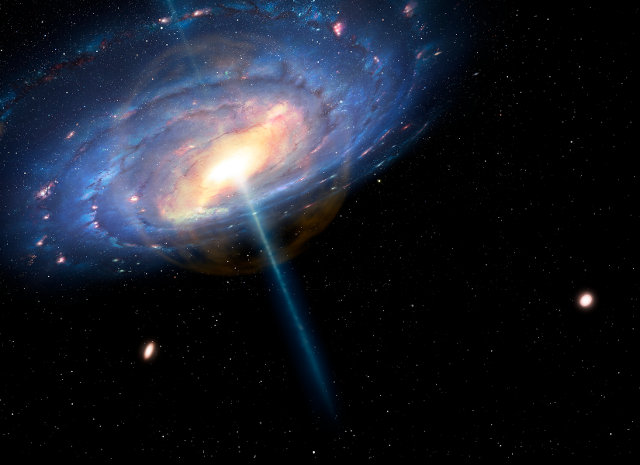
Artistic concept of the Milky Way as a Quasar (Image courtesy Mark A. Garlick/CfA)

An article published in “The Astrophysical Journal” describes a research about the Milky Way that offers a solution to the problem of the missing mass. A team of scientists led by Fabrizio Nicastro, a research associate at the Harvard-Smithsonian Center for Astrophysics (CfA) and astrophysicist at the Italian National Institute of Astrophysics (INAF), used ESA’s XMM-Newton space telescope to discover a kind of gaseous fog that absorbs emissions from distant sources. The existence of such a bubble indicates that some millions of years ago the Milky Way was a quasar.

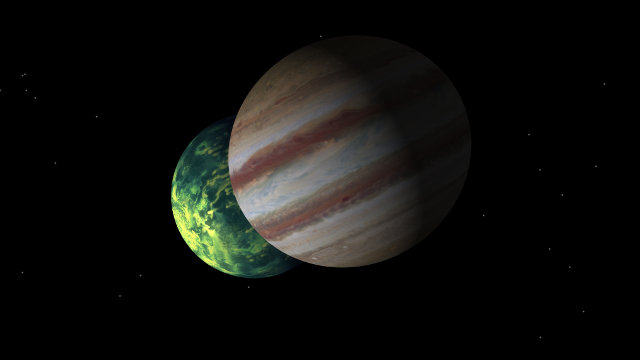
Jupiter compared to the hot-Jupiter HD 189733b (Image NASA/JPL-Caltech)

According to an astronomer estimate the Milky Way alone could host one billion gas giant planets like Jupiter. Twenty years of exoplanet discoveries and studies taught us that there are different types of Jovians and their study is important to understand the evolution of a solar system, including our own, given the influence of a planet of that mass. On the other hand, the study of Jupiter also helps our general understand of that class of exoplanets.

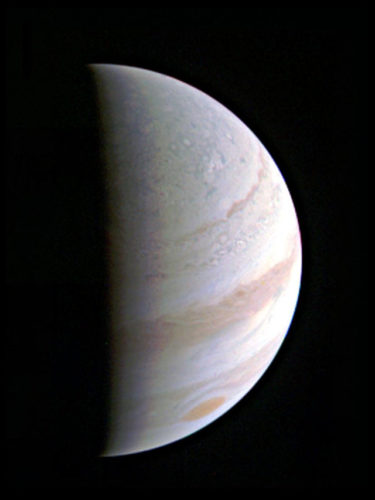
Jupiter seen by the Juno space probe from a distance of 703,000 kilometers on August 27, 2016 (Photo NASA/JPL-Caltech/SwRI/MSSS)

Yesterday NASA’s Juno space probe completed its first Jupiter flyby. At approximately 13:44 UTC it flew just 4,200 kilometers (2,600 miles) above the Jovian clouds, the minimum distance scheduled throughout its primary mission. At that point, Juno was traveling at about 208,000 km/h (130,000 mph) compared to the planet. This is the first of 36 flybys planned in the two and a half years of its primary mission.