2016

The area around dwarf galaxy DDO 68 with a possible satellite seen by LBT (Image courtesy Francesca Annibali/INAF)

An article published in “The Astrophysical Journal Letters” describes a research about the dwarf galaxy DDO 68. An international team of researchers led by Francesca Annibali of the National Institute for Astrophysics (INAF), Italy, used the Large Binocular Telescope (LBT) to make observations that allowed to find evidence that even a very small galaxy can capture smaller galaxies.

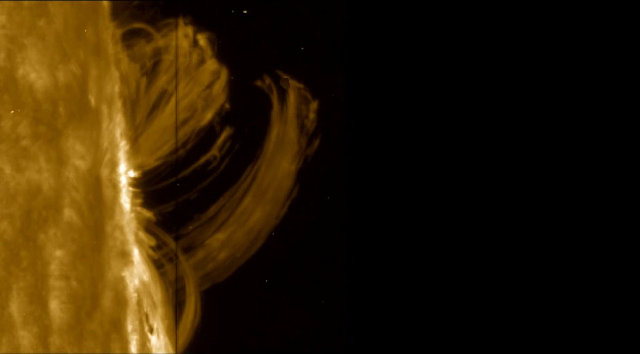
A moment of the July 24, 2016 solar flare (Image NASA's Goddard Space Flight Center; Joy Ng, producer/IRIS/Lockheed Martin Solar and Astrophysics Laboratory)

NASA released the images captured by its IRIS space probe that show a kind of rain that fell on the Sun on July 24, 2016. This event occurred during a mid-level solar flare that led to the ejection of solar material, plasma at very high temperatures which then fell like rain and for this reason is called coronal rain or in more technical jargon post-flare loops.

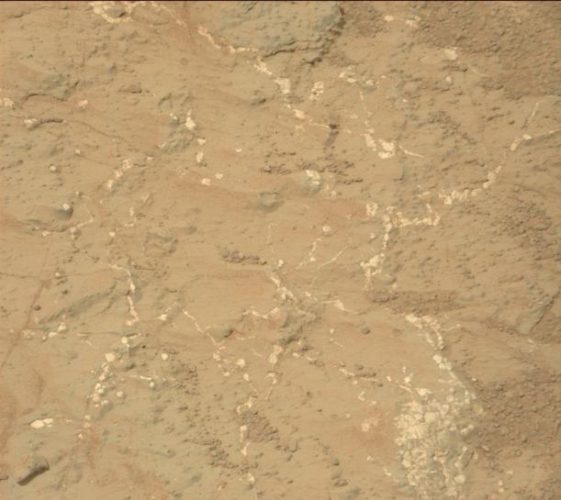
Some mineral veins in Gale Crater (Photo NASA/JPL-Caltech/MSSS)

An article published in the journal “Meteoritics & Planetary Science” describes a research on the ancient lake that existed in today’s Gale Crater on Mars. Scientists at the Open University and the University of Leicester used data collected by NASA’s Mars Rover Curiosity to understand the old conditions in Gale Crater concluding that the environment was similar to the Earth and in favor of the presence of life forms.

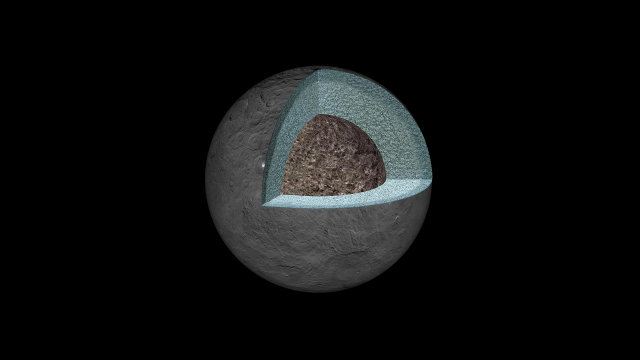
Artistic representation of Ceres' possible internal layers (Image NASA/JPL-Caltech/UCLA/MPS/DLR/IDA)

An article published in the journal “Nature” describes a research about the internal structure of the dwarf planet Ceres. A team led by Ryan Park of NASA’s Jet Propulsion Laboratory (JPL) analyzed very precisely the movements of the Dawn space probe, which is orbiting Ceres, to get clues that suggest that it’s composed of a number of layers with the densest in its core and some weak layers that include ice water.

Artistic representation of Io with its volcanoes and the atmosphere collapsing when it enters Jupiter's shadow (Image SwRI/Andrew Blanchard)

An article published in the “Journal of Geophysical Research” describes a research funded by NASA on the atmosphere of Io, one of the “Galilean” moons of Jupiter. A group of scientists led by Constantine Tsang of the Southwest Research Institute detected the changes taking place in the atmosphere of Io, noting how it collapses when it enters Jupiter’s shadow and the temperature drops.