2016

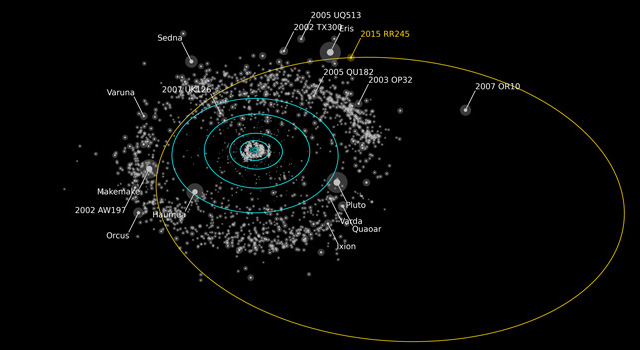
Scheme of the orbits of 2015 RR245 and the objects brighter than it (Image courtesy Alex Parker, OSSOS)

An international team of astronomers discovered the dwarf planet identified for now only as 2015 RR245. Using the telescope on Mount Maunakea, Hawaii, as part of the OSSOS survey, they found 2015 RR245, whose orbit is in the Kuiper belt, the area of ​​the solar system beyond Neptune where there are many icy celestial bodies.

The diameter of the dwarf planet 2015 RR245 has been estimated at around 700 kilometers (about 435 miles), which means it’s a bit smaller than Ceres. In the Kuiper belt there are 17 objects larger that that so this discovery is not at the level of that of a planet or at least of a dwarf planet the size of Pluto or Eris. However, each object discovered out there can tell us something more about the history of the solar system.

Artistic representation of the possible impact of a planetoid with Mars (Image courtesy Université Paris Diderot / Labex UnivEarthS. All rights reserved)

An article published in the journal “Nature Geoscience” describes a research conducted by scientists from Université Paris Diderot and Royal Observatory of Belgium, in collaboration with the CNRS, Université de Rennes 1 and the Japanese Institute ELSI on Deimos and Phobos, Mars moons, which supports the theory of an ancient impact as their origin. It’s complementary to another, independent, led by scientists of the French space agency CNRS and Aix-Marseille Université whose results will be published in “The Astrophysical Journal”.

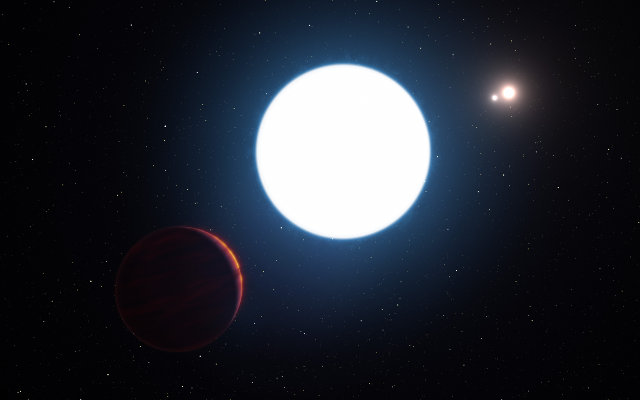
Artistic representation of the HD 131399 system with its exoplanet and its three stars (Image ESO/L. Calçada)

An article published in the journal “Science” describes the discovery of the exoplanet HD 131399Ab, the first ever found in a system with three suns. A team of astronomers led by the University of Arizona used the SPHERE instrument mounted on ESO’s VLT to obtain a direct image of HD 131399Ab and its system’s three stars. Scientists thought that such an orbit was unstable but this case seems to contradict that idea.