2016

Various reconstructions of the gravitational waves detected by the LIGO experiment (Image courtesy LIGO experiment)

During a press conference at the American Astronomical Society meeting in San Diego, the second detection of gravitational waves from the merging of two black holes by the LIGO experiment was announced. It is a different event from the first, historic, one announced on February 11, 2016: this time the merger took place about 1.4 billion years ago and was detected on Earth on December 26, 2015. The event is also described in a article published in the journal “Physical Review Letters”.

Artist's impression of the simultaneous stellar eclipse with the planetary transit events by Kepler-1647b (Image Lynette Cook)

An article published in “The Astrophysical Journal” describes the study of the planet’s characteristics circumbinary Kepler-1647b. By using the Kepler space telescope NASA, a team of scientists at NASA’s Goddard Space Flight Center and the San Diego State University led by Veselin Kostov discovered this planet that orbits two stars. This is not the first case of this kind but it’s the biggest and its year is longer, about three Earth’s years.

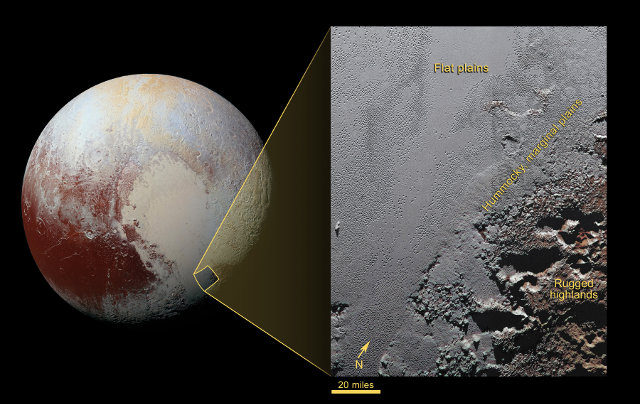
Krun Macula, the borders of Sputnik Planum and their place on Pluto (Image NASA/JHUAPL/SwRI)

NASA released an image of an area of ​​Pluto informally called Krun Macula that shows the variability on the dwarf planet. Obtained by putting together various photographs taken by NASA’s New Horizons space probe during its July 14, 2015 flyby, it shows the border area between the icy plains of the heart-shaped region and the nearby highlands.

Illustration of a hot Jupiter planet with its clouds (Image NASA/JPL-Caltech)

An article published in “The Astrophysical Journal” describes a research about the possible presence of water in the planets of the type called hot Jupiter. Those are gas giants just like Jupiter but orbit very close to their stars and consequently have very high surface temperatures. A team of scientists at NASA’s JPL led by Aishwarya Iyer tried to understand why the atmosphere of some hot Jupiters doesn’t seem to contain water.