2016

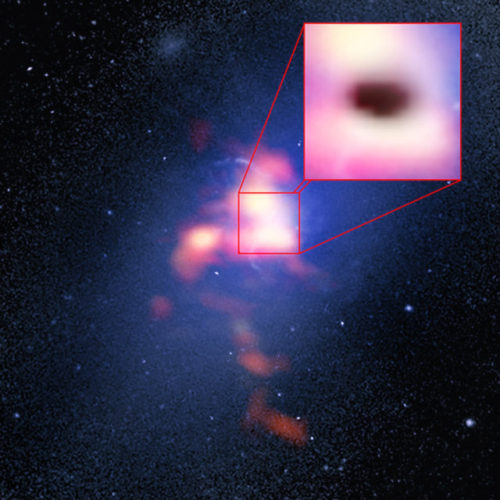
In the background an image taken by the Hubble Space Telescope. In red the gas seen by ALMA (Image B. Saxton (NRAO/AUI/NSF)/G. Tremblay et al./NASA/ESA Hubble/ALMA (ESO/NAOJ/NRAO))

An article published in the journal “Nature” describes the observation of an intergalactic deluge of gases that from large clouds are falling toward the supermassive black hole at the center of a galaxy in the Abell 2597 cluster. By using the ALMA radio telescope a team of astronomers led by Grant Tremblay of Yale University discovered the first evidence that these huge black holes can gorge on gas through chaotic and clumpy rains of giant clouds of very cold molecular gas.

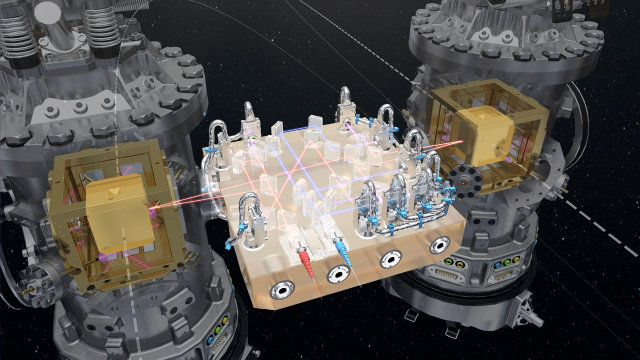
Illustration of the device in the LISA Pathfinder space probe (Image ESA/ATG medialab)

Yesterday ESA held a press conference to announce the results of the LISA Pathfinder space probe’s tests. This demonstration mission of the technologies needed to detect gravitational waves in space has been called a success beyond expectations. The mission team scientists published an article in the journal “Physical Review Letters” which describes the test results.

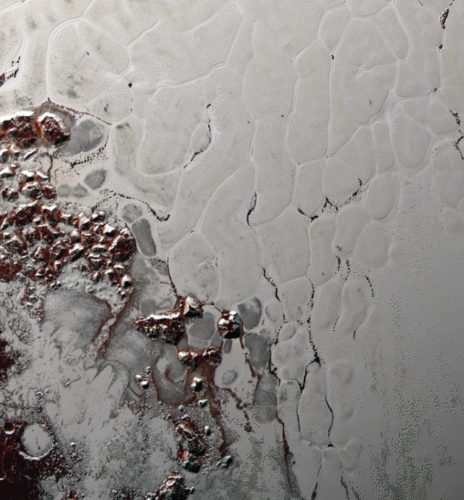
An area about 400 km (250 miles) long in Pluto's Sputnik Planum region (Image NASA/JHUAPL/SwRI)

Two articles published in the journal “Nature” describe a research about the heart-shaped geological formation on the dwarf planet Pluto. NASA’s New Horizons mission scientists determined various characteristics of the area, informally called Sputnik Planum, explaining that a phenomenon called convection renews its surface over time. Using the images taken by the New Horizons space probe, another research revealed new details on Pluto’s atmosphere.

The possible scenario of the impact that created the Moon (a) and the following arrival of water (b) (Image Jessica J. Barnes et al.)

An article published in the journal “Nature Communications” describes a research about the water on the Moon and concluded that it was brought mostly by asteroids that struck it between 4.5 and 4.3 billion years ago. Until now, scientists generally thought that water was transported by comets but according to the international team led by Jessica Barnes of the British Open University things are different.

The galaxy UGC 9391 seen by the Hubble Space Telescope. Cepheid variable are in red circles, a type Ia supernova is marked by a blue cross (Image NASA, ESA, and A. Riess (STScI/JHU))

An article accepted for publication in “The Astrophysical Journal” describes a research based on observations made with the Hubble Space Telescope that suggests that the universe is expanding at a faster rate than expected. A team of astronomers led by Nobel laureate Adam Riess measured the distance of stars in nineteen galaxies with the best accuracy ever achieved to obtain this surprising result.