2016

Color global map of Ceres (Image NASA/JPL-Caltech/UCLA/MPS/DLR/IDA)

At the 47th Lunar and Planetary Science Conference held last week in The Woodlands, Texas, new results were presented of the analyzes of data collected about the dwarf planet Ceres by NASA’s Dawn space probe. Some of the mission scientists presented a new color map of Ceres surface and new highly detailed pictures of Occator crater, famous for the presence of the largest among the white spots, but also other interesting craters, especially Oxo, where water was found.

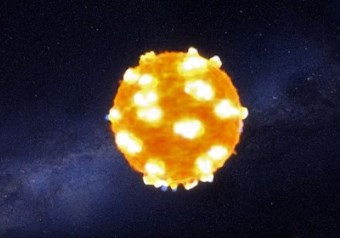
Shockwave breaking out of a star's surface (Image NASA)

An article accepted for publication in the journal “Astrophysical Journal” describes the shock wave generated by a supernova observation, captured for the first time at visible light due to strong flash that generates when erupts from the star’s surface. An international team directed by astrophysicist Peter Garnavich of the University of Notre Dame in Indiana analyzed data collected by the Kepler space telescope about 50 trillion stars to make this discovery.

The Orbital ATK Cygnus "Rick Husband" space cargo ship blasting off atop an Atlas V rocket (Image NASA TV)

A few hours ago the Orbital ATK’s Cygnus spacecraft blasted off atop an Atlas V rocket from Cape Canaveral. After about twenty minutes it successfully separated from the rocket’s last stage and was placed on its route. It’s in its fifth official mission, called Orbital-6 or simply Orb-6 but also CRS OA-6, of supply transport to the International Space Station for NASA.

ALMA image of HL Tau at left; VLA image, showing clump of dust, at right (Image Carrasco-Gonzalez, et al.; Bill Saxton, NRAO/AUI/NSF)

An article submitted to “Astrophysical Journal Letters” describes a research on the forming planets in the HL Tauri system. An international team used the Karl G. Jansky Very Large Array (VLA) radio telescope to observe new details of what appear to be the first stages of the aggregation of dust and various materials around their star.