January 2017

Global soil moisture map (Image MIT/NASA/JPL-Caltech)

An article published in the journal “Nature Geoscience” describes an analysis of data collected during the first year of NASA’s SMAP satellite’s mission. The results were surprising, especially because the data about the soil’s upper layer has a kind of memory of weather, more than you might think from theoretical models or from incomplete surveys carried out prior to this mission.

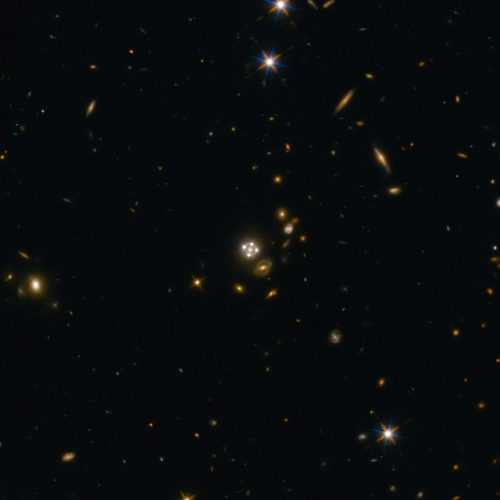
The quasar HE0435-1223 seen through a gravitational lens that creates four images of it (Image ESA/Hubble, NASA, Suyu et al.)

A series of articles about to be published in the journal “Monthly Notices of the Royal Astronomical Society” describes various aspects of a new calculation of the Hubble constant, the value indicating the rate of expansion of the universe. A team of the H0LiCOW collaborative used the Hubble Space Telescope and other telescopes to measure the Hubble constant using the effect of gravitational lensing of 5 galaxies.

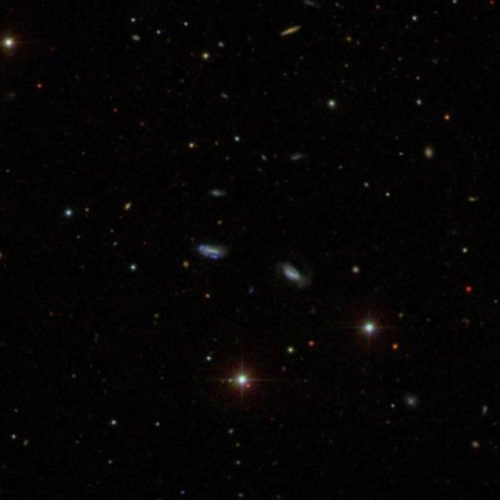
A group of dwarf galaxies (Image courtesy Sloan Digital Sky Survey)

An article published in the journal “Nature Astronomy” describes the discovery of seven groups of dwarf galaxies that show the conditions for starting the merger process that will lead to form galaxies like the Milky Way. A team of researchers led by Sabrina Stierwalt of the National Radio Astronomy Observatory (NRAO) identified seven groups starting from data of the TiNy Titans (TNT) survey then carried out specific studies.

SpaceIL lander (Image courtesy SpaceIL)

The Google Lunar XPRIZE announced the $1 million Diversity Prize, which will be split among the 16 teams participating in the competition. The most important announcement concerns the 5 teams that are advancing to the final phase of the competition having proved they have valid contracts for the launch of their vehicle to the Moon by December 31, 2016. The final goal is to bring a robotic spacecraft to the Moon that after the landing has to travel at least 500 meters on the surface and send images and data back to Earth.

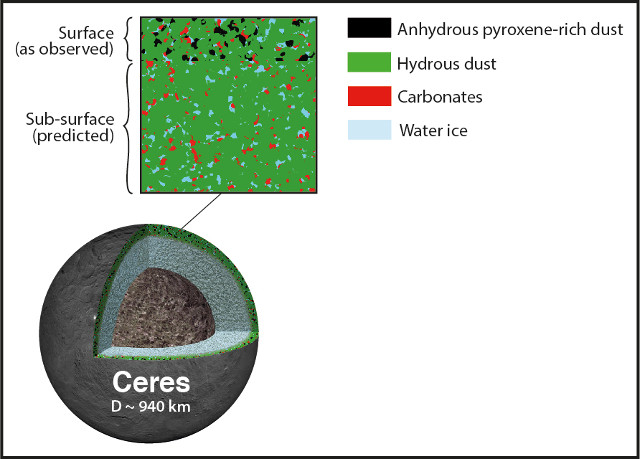
Section of Ceres with the materials at and just below its surface (Image Pierre Vernazza, LAM–CNRS/AMU)

An article published in “The Astronomical Journal” describes a research on the surface of the dwarf planet Ceres. Using infrared observations carried out with the SOFIA observatory a team of scientists of the Laboratoire d’Astrophysique de Marseille, SETI and NASA’s JPL identified the presence of pyroxene, clay and carbonates that so far deceived the researchers, who thought the surface was rich in carbon compounds.