January 2017

Pluto and Charon (Image NASA-JHUAPL-SwRI))

An article published in the journal “Icarus” describes a research on Charon, the biggest moon of the dwarf planet Pluto, and on one aspect of the relationship between the two of them. A team of researchers at the Georgia Institute of Technology made a series of computer simulations that indicate that the passage of Charon between Pluto and the Sun slows the dwarf planet’s atmosphere loss. The predictions are consistent with the data collected by NASA’s New Horizons space probe.

NGC 1448 in an image combining data from the Carnegie-Irvine Galaxy Survey in the optical range and NuSTAR in the X-ray range (Image NASA/JPL-Caltech/Carnegie-Irvine Galaxy Survey)

At the American Astronomical Society meeting the results of the study of galaxies NGC 1448 and IC 3639 were presented showing how they led to the identification of supermassive black holes at their centers. A team of researchers used NASA’s NuSTAR Space Telescope to detect the high energy X-ray emission from them and see beyond the dust and gas that hid those areas.

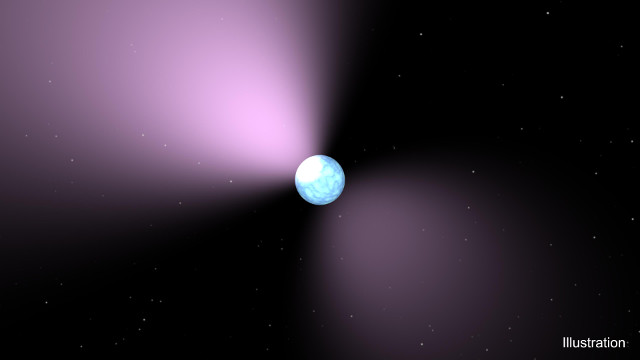
Artist's concept of a neutron star (Image NASA/JPL-Caltech)

An article published in “Astrophysical Journal Letters” describes a research, also presented recently at the meeting of the American Astronomical Society, about the pulsar known as PSR J1119-6127. Discovered over 16 years ago, recently it showed behaviors typical of a magnetar, a different type of neutron star. This oddity might help explain the link between pulsars and magnetars and the evolution of neutron stars.

Views of the galaxy PGC 1000714 (Image courtesy Ryan Beauchemin)

An article published in the journal “Monthly Notices of the Royal Astronomical Society” describes the discovery of a galaxy of a very rare type, with a central core surrounded by a pair of rings. Called PGC 1000714, it was discovered by a group of researchers at the University of Minnesota Duluth and the North Carolina Museum of Natural Sciences who recognized it as similar to the Hoag’s object, a ring galaxy.

Global view of the Orion A molecular cloud (Image ESO/VISION survey)

An article published in the journal “Astronomy & Astrophysics” describes the most detailed view of the molecular cloud called Orion A, one of the two giant molecular clouds in the Orion molecular cloud complex. A team of researchers created it by putting together infrared images obtained from the VISION (Vienna Survey in Orion) survey with ESO’s VISTA telescope revealing many young stars and other objects normally hidden within dust clouds.