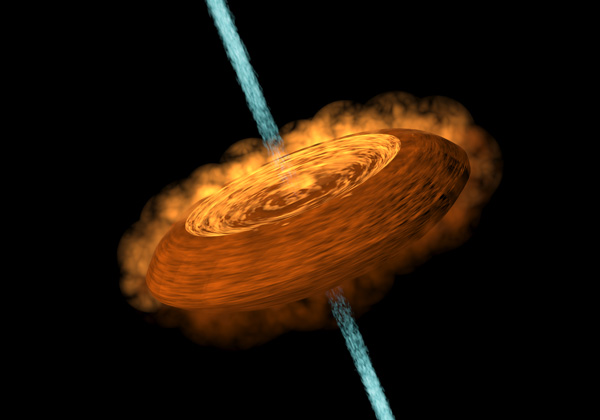
An article published in the journal Science Advances describes the detection of a protostar named HH 212 that is feeding on an accretion disk. A team led by Chin-Fei Lee of the Academia Sinica Institute of Astronomy and Astrophysics (ASIAA, Taiwan) used the ALMA radio telescope to capture a moment of still little known phase of formation of stars and perhaps even of their planets.
The HH 212 protostar system is about 1,300 light years away from Earth and the estimated age of protostar is about 40,000 years. The HH indicates that it’s a Herbig-Haro object, a ionized gas nebula that emits a weak light. It’s a type of nebula typical of a star formation with ionized gas jets ejected from a protostar’s poles.
In astronomical terms, we’re witnessing the birth of a star that currently has a mass between 20% and 30% of the Sun’s. The instruments available in the past years identified a kind of flat envelope around the protostar, the ALMA radio telescope, inaugurated in March 2013, allowed to detect much better the disk’s shape.
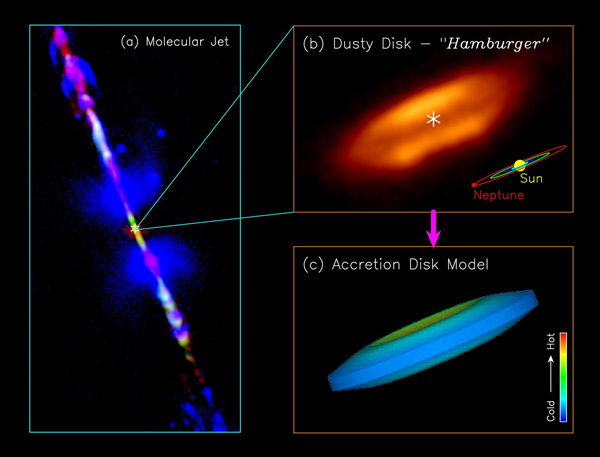
This disk has a radius about 60 times the distance of the Earth from the Sun. The observations showed a kind of equatorial dark lane pressed between two brighter features. This is the first time that such a lane has been seen at submillimetric wavelengths. It’s caused by the relatively low temperature and the optical depth of the disk’s midplane. The researchers compared this look to a hamburger that nourishes the protostar but accretion disks in other systems may have different shapes.
The disk’s shape is linked to certain phenomena that take place in the early stages of star formation. According to current models, active magnetic fields can cause delaying effects on the rotating materials, so much that this phenomenon is called “magnetic braking”. Studying the disk surrounding the protostar HH 212, the researchers noted that this phenomenon might be not so efficient.
The disk is only a part of the HH 212 system, shown in the image above. In section “a” there’s a composite image from observations conducted by different telescopes of the gas jets emitted from the protostar’s poles that have a considerable extension. Section “b” shows the disk and the asterisk at its center shows the probable protostar’s location. Section “c” shows a model of the disk that reproduces the observed dust emissions.
The Herbig-Haro object phase is considered brief in astronomical terms, meaning it should last no more than a few hundred thousand years. Astronomers will have all the time to observe that star formation phase in the HH 212 system and perhaps the beginning of the formation of planets from the disk that could remain around the star.