
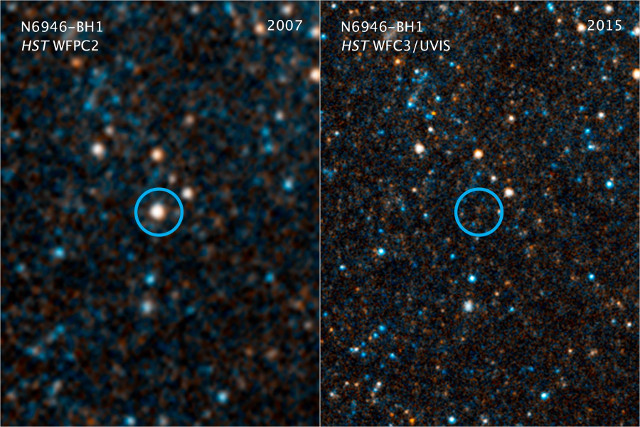
A possible star collapsed into a black hole without exploding in a supernova
An article published in the journal “Monthly Notices of the Royal Astronomical Society” describes the discovery of a massive star called N6946-BH1 that collapsed and seems to have formed a black hole directly without exploding into a supernova. A team of astronomers led by Christopher Kochanek used the Large Binocular Telescope (LBT) in Arizona and NASA’s Hubble and Spitzer space telescopes to observe for the first time this phenomenon, which could explain why there are less supernovae than expected.
