
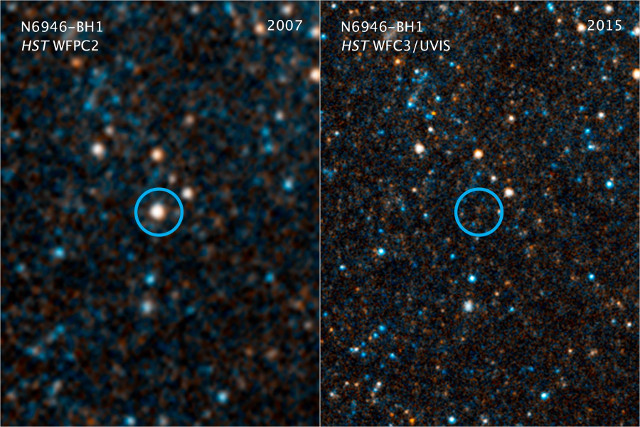
An article published in the journal “Monthly Notices of the Royal Astronomical Society” describes the discovery of a massive star called N6946-BH1 that collapsed and seems to have formed a black hole directly without exploding into a supernova. A team of astronomers led by Christopher Kochanek used the Large Binocular Telescope (LBT) in Arizona and NASA’s Hubble and Spitzer space telescopes to observe for the first time this phenomenon, which could explain why there are less supernovae than expected.
According to current models about the end of stars’ life, a black hole forms from the core of a star remaining after a supernova ejected its other layers in an extremely bright event. For example, the NGC 6946 galaxy is 22 million light years from Earth but telescopes have detected various supernovae, so much so that this galaxy has been nicknamed “Fireworks”. It also hosts the star N6946-BH1, which was was under observation since 2009 but seems to have made a very different and surprising end.
In 2009, observations made with LBT allowed to detect a slight increase in the brightness of the star N6946-BH1. For this reason, it was reported among possible stars in the process of exploding or as failed supernova, that is a star showing the first signs that is going to become a supernova but then doesn’t explode. A sudden increase in brightness is a sign of that kind, so N6946-BH1 became an interesting object of observation.
The investigation on the star N6946-BH1 had an unexpected turn in 2015 when it completely disappeared. It was a star with an estimated mass of 25 solar masses and, moreover, a red supergigant with a huge volume and an initial brightness about 100,000 times higher than the Sun’s, certainly not a little star of which they can lose trace because of its distance. To search for its trace, even at infrareds, the astronomers also used the Hubble and Spitzer space telescopes but where N6946-BH1 used to be there was nothing left.
After carefully evaluating the collected data, the astronomers concluded that the most likely hypothesis is that the star N6946-BH1 collapsed on itself until it became a black hole. In essence, it could be the first failed supernova discovery and what has so far been a theoretical concept could find a confirmation, paving the way for new models on the final phase of massive stars’ life.
Scott Adams, who recently earned a PhD with this work and is one of the authors of the article, pointed out that during the research conducted along with his colleagues six supernovae were detected in the monitored galaxies. This suggests that the possibility that between 10% and 30% of massive stars die as failed supernovae.
The area where the star N6946-BH1 used to be will have to be further examined, for example trying to detect X-rays that could be emitted by the black hole that was born from its collapse to confirm its formation. In that case, it will be possible to proceed with the next phase of the research to find other cases of this type and to refine the rough preliminary estimate of the amount of massive stars that die as failed supernovae.


Permalink