May 2018

The Falcon 9 rocket with a Block 5 first stage blasting off (Image courtesy SpaceX. All rights reserved)

A few hours ago the Bangabandhu-1 was launched from Cape Canaveral on a Falcon 9 rocket with a first stage in its new version, called Block 5, at its debut. After about 33 minutes it separated from the rocket’s last stage and starte the series of maneuvers that will bring it into a geostationary orbit.

The Block 5 version of the first stage, also called a booster, includes a lot of improvements for the Falcon 9 rocket. SpaceX didn’t reveal all the details but a lot of information were provided by the company’s executives or leaked anyway. Various advancements concern performance, meeting NASA’s demands for manned launches, but above all with concern re-use possibilities, a crucial factor in Elon Musk’s company plans.

Artist's impression of 2004 EW95 (Image ESO/M. Kornmesser)

An article published in the journal “The Astrophysical Journal Letters” describes the study of an asteroid cataloged as 2004 EW95 which confirmed it has anomalous characteristics, being the first in the Kuiper belt to show a considerable carbon content. A team of astronomers used ESO’s VLT to study an asteroid that probably formed in the belt between Jupiter and Mars before being pushed to the outer solar system.

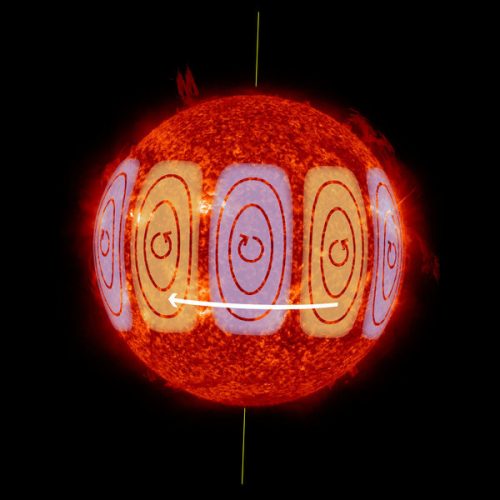
Diagram of solar Rossby waves (Image courtesy MPS/NASA/HormesDesign)

An article published in the journal “Nature Astronomy” describes the evidence of the presence of gigantic waves called Rossby waves on the Sun’s surface. A team of scientists led by the Max Planck Institute for Solar System Research (MPS) and the University of Göttingen discovered these vortices that have sizes comparable to those of the Sun itself, confirming a hypothesis that was proposed decades ago because they exist naturally in rotating fluids.

Artist's representation of WASP-96b (Image courtesy Engine House. All rights reserved)

An article published in the journal “Nature” describes a research on the exoplanet WASP-96b. It’s a hot Saturn, meaning a gas giant with a Saturn-like mass and an orbit close to its star which has as a consequece a high temperature on its surface. A team of researchers led by Nikolay Nikolov of the British University of Exeter used the FORS2 spectrograph mounted on ESO’s VLT to study WASP-96b discovering strong traces of sodium, an observation possible only in the absence of clouds in its atmosphere.

The Dragon cargo spacecraft departing the International Space Station (Photo courtesy Oleg Artemyev)

A few hours ago the SpaceX Dragon spacecraft ended its CRS-14 (Cargo Resupply Service 14) mission for NASA splashing down smoothly in the Pacific Ocean a little more than 420 kilometers (about 326 miles) off the coast of California. The Dragon left the International Space Station a few hours before.

Shortly after landing, SpaceX boats went to retrieve the Dragon to transport it to the coast. The cargo brought back to Earth will be delivered to NASA soon, probably tomorrow. The Dragon spacecraft reached the International Space Station on april 4, 2018.