
July 2018

Scheme of Hubble and Gaia at work (Image NASA, ESA, and A. Feild (STScI))

An article published in the journal “The Astrophysical Journal” describes a new measurement of the expansion of the universe. A team of astronomers led by Nobel Prize winner Adam Riess combined observations made with the Hubble Space Telescope and those made with ESA’s Gaia space probe, an observatory that specifically aims to map billions of objects in the sky including the variable stars called Cepheid variable used for those measurements. The new results increase the accuracy but also the discrepancy between the measures of the expansion of the near universe and those of the early universe.

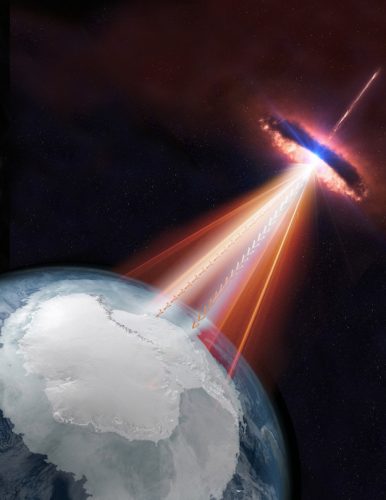
Artist's concept of a blazar emitting neutrinos and gamma rays (Image courtesy IceCube/NASA)

Various articles published in different journals shows various aspects of a research that allowed to associate a neutrino detected by the IceCube instrument at the South Pole to the blazar known as TXS 0506+056. In an article published in February 2018 in “The Astrophysical Journal Letters” a team led by Simona Paiano of the INAF of Padua showed that connection. In two articles just published in the journal “Science”, groups of scientists from 18 different observatories describe what was defined multimessenger observations of neutrino and electromagnetic emissions and a second analysis showing that other neutrinos detected by IceCube came from the same source.

Artitst's concept of Enceladus and Saturn (Image NASA/JPL-Caltech)

Two articles published in the journal “Geophysical Research Letters” describe studies concerning the planet Saturn’s system based on information obtained from the Cassini space probe during what was called the Grand Finale, the orbits close to Saturn performed in the weeks preceding the end of that extraordinary mission. In particular, the audio was generated that contains sound obtained by converting the electromagnetic emissions discovered between Saturn and its rings and Enceladus generated by movements of plasma between them.

The Progress MS-9 cargo spacecraft blasting off atop a Soyuz 2.1a rocket (Image NASA TV)

A few hours ago the Progress MS-9 spacecraft blasted off atop a Soyuz 2.1a rocket from the Baikonur Cosmodrome in Kazakhstan. After about nine minutes it successfully separated from the rocket’s last stage and was placed on its ultra-fast track in its resupply mission to the International Space Station also called Progress 70 or 70P. After less than 4 hours it reached the International Space Station docking with its Pirs module.

Artist's impressione of the Milky Way and the Sausage dwarf galaxy (Image courtesy V. Belokurov (Cambridge, UK); Based on image by ESO/Juan Carlos Muñoz)

A series of articles published in the journals “Monthly Notices of the Royal Astronomical Society” and “The Astrophysical Journal Letters” or on the arXiv website describe various aspects of a study on the consequences of the merger of the Milky Way and a dwarf galaxy nicknamed Sausage. A team of astronomers used data collected by ESA’s Gaia space probe to reconstruct that event from 8-10 billion years ago that profoundly influenced the Milky Way.