August 2018

An ancient galaxy with a frantic star formation

An article published in the journal “Nature” describes the mapping of a galaxy known as COSMOS-AzTEC-1 that showed peculiar characteristics. A team of astronomers used the ALMA radio telescope to study this starburst galaxy, a class in which there’s considerable star formation. COSMOS-AzTEC-1 is very far away so we see it as it was 12.4 million years ago and very massive and could be the progenitor of today’s large elliptical galaxies so this type of research could provide new information on their evolution.

The New Horizons space probe has photographed its next target Ultima Thule

NASA has published an image captured by its New Horizons space probe in which its LORRI instrument detected Ultima Thule, the Kuiper belt object – but there may be two objects and/or a moon – that represents its next target for a flyby scheduled for New Year’s Day 2019. When the 48 photos combined in the image were taken, on August 16, 2018, New Horizons was still about 172 million kilometers (107 million miles) from Ultima Thule and being able to identify its target is positive because mission managers can start assessing any adjustments to the probe’s course.

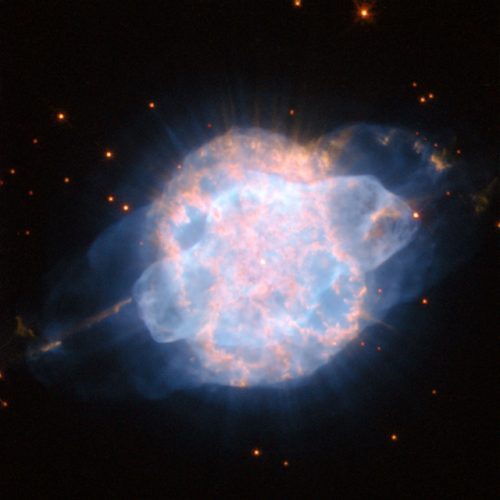
NGC 3918 (Image ESA/Hubble and NASA)

A new image captured by the Hubble Space Telescope shows the planetary nebula NGC 3918, nicknamed the “Blue Planetary” or “The Southerner”. Its shape in some ways reminds of an eye with special colors and seeing it is a lucky event because it will not last long in astronomical terms since this phase will end within a few tenth of millennia.

Milky Way panorama (Image ESO/S. Brunier)

An article published in the journal “Nature” describes a research on star formation in the Milky Way. According to Masafumi Noguchi of Tohoku University there were two star formation periods separated by 2 billion years. In essence, our galaxy had a first period in which it was vital then it died and after about 2 billion years star formation restarted in a sort of second life. According to this theory, during that period of death the gas present in the Milky Way got enriched with iron, the reason why stars like the Sun have a greater amount of it than others.

The Spitzer Space Telescope getting prepared (Photo NASA)

On August 25, 2003, NASA’s Spitzer Space Telescope was launched from Cape Canaveral on a Delta II rocket. Its primary mission lasted 2.5 years and its success led to a series of extensions even after it ran out of the liquid helium it had on board that was used to keep some instruments at very low temperatures, which determined the end of their use.