
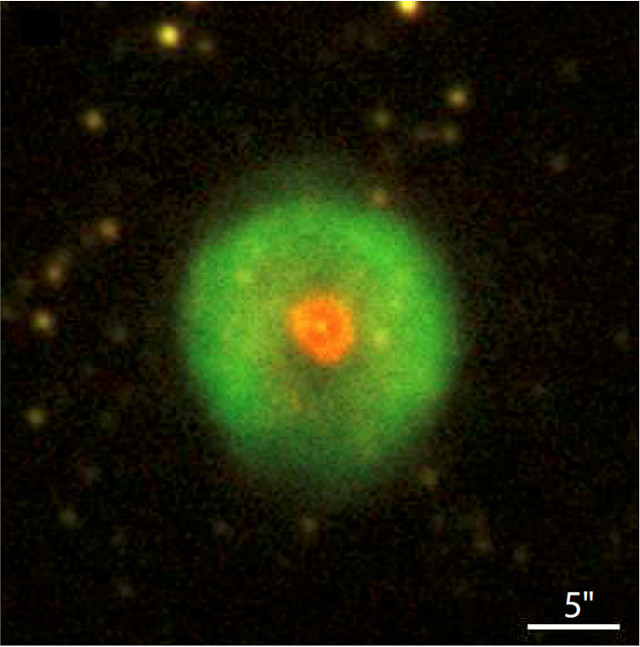
An article published in the journal “Nature Astronomy” describes a research on the planetary nebula HuBi 1. Normally that kind of structure marks a phase of a star’s agony but in this case a team of researchers discovered an nebula that’s inside-out. Their conclusion is that the star at its center is going through a sort of rebirth process so we see it while it’s ejecting materials from its surface and creating a shock wave that excites the nebula’s materials.
The expression planetary nebula is the result of an interpretation error by astronomers who had limited instruments available and mistook them for formations similar to the solar system’s gaseous planets. Actually, they represent a short phase in the life of a star with a mass similar to the Sun when it becomes a red giant and its outer layers get ejected. The ionization caused by the intense ultraviolet emitted by the star’s nucleus causes these layers of gas to emit electromagnetic radiation.
The HuBi 1 planetary nebula turned out to be out of the ordinary when a team of researchers from various institutions including the Spanish Instituto de Astrofísica de Andalucía (IAA-CSIC) and the Chinese University of Hong Kong (HKU) studied it. In about 5 billion years the Sun will enter a similar phase and for a few thousand years in the solar system there will be a planetary nebula, therefore astronomers are very interested in this type of phenomenon.
In the case of the HuBi 1 planetary nebula, about 17,000 light years from Earth, the researchers realized with surprise that its inner regions are less ionized while the outer ones are more ionized. That’s the opposite of what normally happens in this type of nebula because a red giant star that is contracting to enter its final phase as a white dwarf becomes warmer and starts ionizing the materials of the stellar wind around it so the ones closest to the star are normally the most ionized materials while the farthest gases are less ionized.
Planetary nebulae can have different shapes and structures depending on the moment in which they’re seen and the processes taking place inside them, but some of them have a spherical shape. The Southern Owl Nebula is extraordinarily symmetrical and round so it’s a good comparison for HuBi 1, which however has a double shell: a hydrogen-rich outer one and a nitrogen-rich inner one.
The observations were conducted in particular with the Nordic Optical Telescope in Spain and then the research included the participation of theoretical astrophysicists to try to understand what was happening in the HuBi 1 planetary nebula. The mass of the progenitor star was slightly higher than the Sun’s and now what’s left, a white dwarf or an object that almost reached that status, is surprisingly cold and metal-rich.
According to the researchers it’s possible that the inner nebula got excited by the passage of a shock wave caused by the star that ejected materials in an abnormally late phase of its evolution, almost at the end of its agony. The materials cooled to form dust around the star and this explains why its brightness dropped rapidly over the last 50 years. Without ionized photons from the central star, the outer nebula started recombining, losing ionization and becoming neutral.
Dr. Xuan Fang, one of the authors of the research, explained that the conclusion of his team is that they observed HuBi 1 at the exact moment when the central star went through a sort of rebirth process that’s very brief from an astronomical point of view. The lack of hydrogen and the wealth of metals are rare characteristics for a star that’s becoming a white dwarf so this planetary nebula is really interesting to study.
One wonders if processes like those seen in the HuBi 1 planetary nebula are exceptional or if there’s a class of these objects we didn’t know because they don’t last long so the approximately 3,000 we know are a lot but still represent a limited sample. The research on planetary nebulae continues to try to understand what we can expect in the distant future of the solar system and their possible influence on the evolution of galaxies due to the materials ejected in interstellar space.
