2018

An article published in the journal “Nature Geoscience” describes a research into the possibilities that the salt water beneath the surface of Mars contains oxygen. A team of researchers created a series of simulations based on the possible conditions existing in those environments, concluding that there can be oxygen in the case of exchanges with the atmosphere. This means that it’s possible that in the underground lake containing very salty liquid water of which the discovery was announced in July 2018 there’s some possibility that life forms exist that use oxygen in their metabolism.

A new study of the youngest pulsar discovered in the Milky Way

An article published in the journal “The Astrophysical Journal” describes the study of a pulsar cataloged as PSR J1846-0258 found among the remnants of a supernova called Kes 75. A team of researchers used information collected with NASA’s Chandra X-ray observatory between 2000 and 2016 to study the pulsar’s characteristics. They confirmed that it’s the youngest discovered in the Milky Way and could help to better understand that kind of objects, also because they discovered a pulsar wind nebula, a cloud of gas around it created thanks to a very elevated rotation and magnetic field.

BepiColombo's space probe blasting off atop an Ariane 5 rocket (Photo courtesy ESA-CNES-Arianespace)

A few hours ago the two space probes of ESA and JAXA’s BepiColombo mission blasted off on an Ariane 5 ECA rocket from the Kourou base in French Guiana. Almost 27 minutes after launch, the spacecraft regularly separated from the rocket’s last stage along with the Mercury Transfer Module (MTM), which will provide the propulsion through its ion engines to transport the probes to the planet Mercury.

The Hyperion proto-supercluster (Image ESO/L. Calçada & Olga Cucciati et al.)

An article published in the journal “Astronomy & Astrophysics” describes the discovery of a huge galaxy proto-supercluster with a mass close to that of the largest existing structures in the recent universe. A team led by Olga Cucciati of the Italian Institute for Astrophysics, Bologna discovered it thanks to the data collected by the VUDS (VIMOSUltra-Deep Survey) project and named it Hyperion after the titan because it’s really titanic. the researchers estimated that this structure dates back about 2.3 billion years after the Big Bang, the largest and most massive discovered dating back to such a remote era with a mass estimated at over a million billion times the Sun’s.

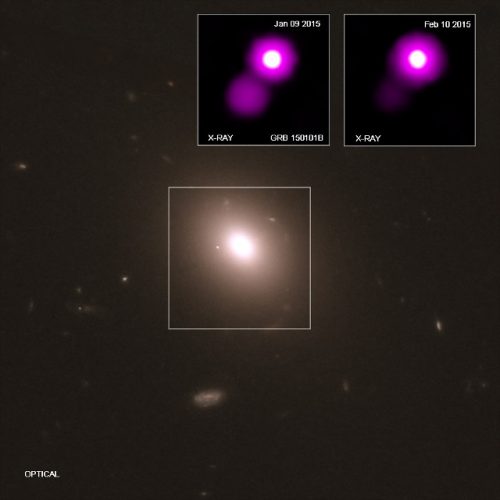
A gamma-ray burst from 2015 shows many similarities with a neutron star merger

An article published in the journal “Nature Communications” describes an analysis of the gamma-ray burst cataloged as GRB150101B. A team of researchers led by Eleonora Troja of NASA pointed out the similarity between this gamma-ray burst and the electromagnetic signals emitted by the event cataloged as GW170817, the neutron star merger detected at both electromagnetic waves and gravitational waves. A year after the sensational announcement of that event, the authors of this new research believe they have discovered another one of that type.