2018

NASA's 60th anniversary logo (Image NASA)

On October 1, 1958, NASA (National Aeronautics and Space Administration) began its activity. Officially created on July 29, 1958 following the National Aeronautic and Space Act signed by US President Dwight D. Eisenhower, it replaced NACA (National Advisory Committee for Aeronautics), which was created to develop military projects. NASA was created as a civilian agency to carry out development in the aeronautical and, above all, space sector with peaceful goals.

A tail for a group of galaxies attracted by the Abell 2142 cluster

An article published in the journal “Astronomy & Astrophysics” describes the observation of a small group of galaxies attracted by the galaxy cluster Abell 2142 and approaching it a trail of very hot gas was created. A team of researchers led by Dominique Eckert, now at the German Max Planck Institute for Extraterrestrial Physics, used NASA’s Chandra X-ray space observatory to detect the emissions from a sort of tail that extends over a million light years.

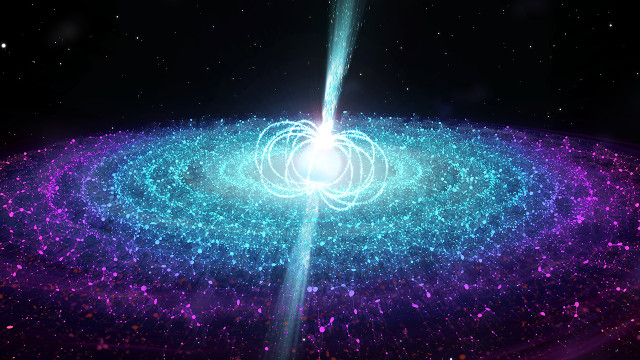
Artist's concept of neutron star with jets of material, magnetic field and accretion disk (Image courtesy ICRAR/Universiteit van Amsterdam)

An article published in the journal “Nature” describes the discovery of a pulsar-type neutron star with a very strong magnetic field that emits a jet of materials. A team of researchers used the Very Large Array (VLA) radio telescope to study the neutron star cataloged as Swift J0243.6+6124 and simply called Sw J0243 discovering an anomaly because according to the formation models for jets of material a pulsar with such a strong magnetic field shouldn’t be able to emit them.

The HTV-7 "Kounotori" cargo spacecraft captured by the Canadarm2 robotic arm (Image NASA TV)

A little while ago the HTV-7 “Kounotori” spacecraft was captured by the International Space Station’s Canadarm2 robotic arm, operated by Drew Feustel with the assistance of Serena Auñón-Chancellor. The Japanese space cargo ship, which blasted off last Saturday, carries a huge amount of supplies and experiments. After its capture, it will take a little while before the HTV-7 starts getting moved to its berthing location on the Harmony module.

Titan seen by Cassini (Image NASA/JPL-Caltech/University of Arizona/University Paris Diderot/IPGP)

An article published in the journal “Nature Geoscience” reports the evidence of the presence of dust storms in the equatorial regions of Titan, the largest of Saturn’s moons. A team of researchers analyzed data collected by the Cassini space probe to find those evidence that make Titan the third object in the solar system where dust storms were discovered after the Earth and Mars. This is a further similarity between Titan and the Earth.