2018

Artist's concept of Patroclus and Menoetius (Image courtesy W.M. Keck Observatory/Lynette Cook)

An article published in the journal “Nature Astronomy” describes a research on the migration of the solar system’s gaseous planets. A team of scientists studied two asteroids called Patroclus and Menoetius that are out of the ordinary as they form a pair of Jupiter trojans, which means that they orbit at a point of equilibrium of the Sun-Jupiter system. Their conclusion is that their existence is evidence of the shifting of the gaseous planets’ orbits.

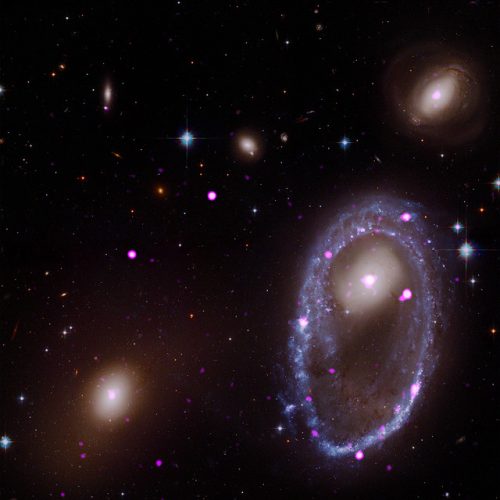
A ring galaxy with a lot of ultraluminous X-ray sources

An article published in the “Astrophysical Journal” describes the detection of a series of X-ray sources in the ring of the galaxy AM 0644-741. A team of researchers led by Anna Wolter from INAF-Osservatorio Astronomico di Brera, Italy, used observations from NASA’s Chandra X-ray Observatory to discover those ultraluminous sources concluding that the ring containing them consists of binary systems that include black holes or neutron stars and that the ring formed following a collision between galaxies.

A relativistic jet after the kilonova

An article published in the journal “Nature” describes the observations of a relativistic jet that followed the merger between two neutron stars discovered in August 2017, the first case of an event detected and studied in both electromagnetic and gravitational waves. A team of researchers used the precise measurements made with some radio telescopes to establish that a narrow jet of particles was emitted at a speed close to that of light after the event.

A false-color submillimeter-wavelength image of the IRAS 15398-3359 system (Image courtesy Yuki Okoda, Graduate School of Science, The University of Tokyo. All rights reserved)

An article published in the “Astrophysical Journal Letters” describes a study on the co-evolution of stars and protoplanetary disks based on the class 0 protostar cataloged as IRAS 15398-3359. A team of astronomers from the Department of Physics at the University of Tokyo led by Professor Yoko Oya used the ALMA radio telescope for this research, discovering a dense disk of materials around the protostar that could be a precursor to a planetary system. This discovery could improve our knowledge of the formation of solar systems.

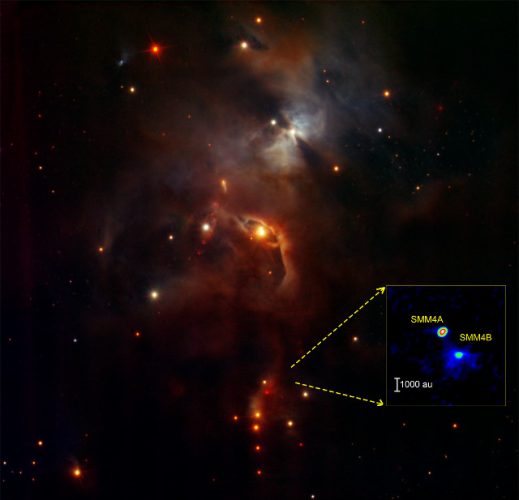
The Serpens Main star-forming cluster with SMM4A and SMM4B in the inset (Image ESO/ALMA(ESO/NAOJ/NRAO)/Aso et al.)

An article published in the “Astrophysical Journal” describes the observation of the growth of two class 0 protostars. A team led by Dr. Yusuke Aso of the Academy Sinica Institute of Astronomy and Astrophysics (ASIAA, Taiwan) used the ALMA radio telescope to study their different evolutionary states obtaining a series of details on the protostars cataloged as SMM4A and SMM4B. Class 0 protostats have their peak emissions at submillimetric wavelengths making ALMA ideal to get to know star gestation better.