2018

Sputnik Planitia

An article published in the journal “Icarus” describes a research that offers an explanation for the formation of the dwarf planet Pluto. A team of scientists from the Southwest Research Institute (SwRI) put together data collected by NASA’s New Horizons space probe and data collected by ESA’s Rosetta space probe, which studied comet 67P/Churyumov-Gerasimenko, concluding that Pluto formed by the union of about a billion comets similar to it.

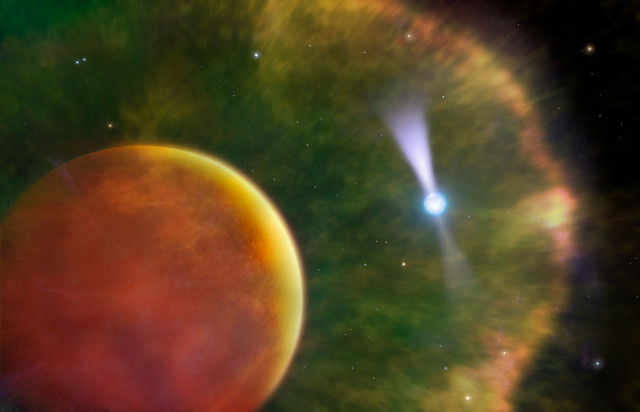
Illustration of PSR B1957+20 and its companion

An article published in the journal “Nature” describes a high resolution observation of a pulsar cataloged as PSR B1957+20. A team of astronomers used data collected using the Arecibo radio telescope, obtaining one of the best results in the history of astronomy thanks to the presence of a trail of plasma left by a brown dwarf, a companion of the pulsar in a binary system. According to the astronomers, the lens effect generated suggests that it’s also the cause of fast radio bursts.

2015 BZ509

An article published in the journal “Monthly Notices of the Royal Astronomical Society: Letters” reports the discovery of an asteroid in an orbit near Jupiter’s which has a retrograde orbit, which means that it moves in the opposite direction of the solar system’s planets and most of its celestial bodies. Cataloged as 2015 BZ509, it was discovered in 2014 and the analysis of its orbit with a series of simulations led to the conclusion that it came from another solar system.