
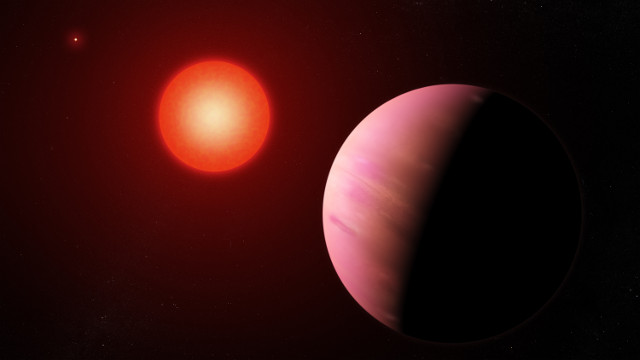
An article published in the journal “The Astronomical Journal” describes the study of the exoplanet K2-288Bb, discovered among the observations made by NASA’s Kepler space telescope with the help of citizen scientists thanks to the Exoplanet Explorers project. Adina Feinstein, a University of Chicago graduate student and lead author of the paper, presented the results at the 233rd meeting of the American Astronomical Society in Seattle held in Seattle.
The Kepler space telescope’s mission ended in October 2018 but left a huge archive of observations that could be examined for a long time. During its K2 mission, conducted from 2014 until its conclusion, it was programmed to orient itself in order to point towards new areas of the sky at the beginning of each three-month observation campaign. The change in position relative to the Sun was sufficient to alter the shape of the Kepler space telescope, in an extremely small but still significant way for very precise measurements that had to be made of the brightness of the observed stars.
The software to prepare the data gathered by the Kepler space telescope was updated over time but initially the first days of observations of each new campaign were discarded and only afterwards the data collected were analyzed but only partially. In the end, those data were added to those of the Exoplanet Explorers program.
In recent years various websites have been created to host scientific projects to which ordinary citizens can collaborate and the Zooniverse platform hosts several of them, including Exoplanet Explorers. Increasingly sophisticated software is used to analyze data such as astronomical observations, allowing much faster and more reliable results, but in some cases the human eye still offers better results, even if slower. In this case, visitors can examine through the Internet astronomical images and report the possible presence of exoplanets.
In May 2017 a possible exoplanet was reported by visitors of Exoplanet Explorers in the orbit of the red dwarf K2-288B, which is about 266 light years from Earth and has a mass and a size about a third of the Sun’s. It’s part of a binary system along with another red dwarf a little larger, about half the Sun’s size. The exoplanet was already among the candidates found by Adina Feinstein along with another student, Makennah Bristow of the University of North Carolina Asheville, and astrophysicist Joshua Schlieder of NASA’s Goddard Space Flight Center. The report by the visitors was the third transit of the planet in front of its star, the one that was needed to confirm its existence.
At that point it was possible to proceed with follow-up observations of the exoplanet K2-288Bb with other telescopes and look for more information in the archive of the data collected by ESA’s Gaia space probe, which is continuing its mapping of stars and other cosmic objects. All this allowed to obtain the first estimates of the characteristics of this planet, starting from its size, which is about 1.9 times the Earth’s, about half of Neptune’s. This puts it in a rare category, given that very few known exoplanets have a size between 1.5 and 2 times the Earth’s.
Essentially, K2-288Bb turns out to be a really interesting exoplanet to be studied to better understand certain processes of planetary evolution. Many astronomers believe that there are mini-Neptunes that lose much of their atmosphere due to the radiation emitted by their star and eventually become super-Earths. Further observations will be needed to understand whether K2-288Bb is a super-Earth or a mini-Neptune.
This discovery shows that citizen scientists can help important astronomical research and confirm that the observations made with the Kepler space telescope will continue to be a source of news for a long time. However, its successor, the TESS space telescope, is already active and a number exoplanets have been confirmed thanks to its work.
