An article (link to the PDF file) published in the journal “Nature” reports the observation of a jet of materials emitted by the black hole V404 Cygni which changed orientation in no more than a few hours. A team led by James Miller-Jones of the Curtin University node of the International Center for Radio Astronomy Research (ICRAR), Australia, used the Very Long Baseline Array radio telescopes to study the area around the black hole during one of its periodic bursts of considerable intensity. This made it possible to observe for the first time jets of materials changing orientation in a few hours or even minutes.
Almost 8,000 light-years from Earth, the V404 Cygni black hole has an estimated diameter of almost 65 kilometers and an estimated mass almost 10 times the Sun’s. It’s part of a binary system together with a class K companion, a normal star a little smaller than the Sun to which it’s stealing materials that enrich an accretion disk around it. These materials heat up in what’s called the corona to the point that they emit very strong electromagnetic radiations, even X-rays and gamma rays. A part of these materials is ejected in jets that have velocities close to that of light. For these characteristics similar to those of quasars, but on a much smaller scale, it’s also classified as a microquasar.
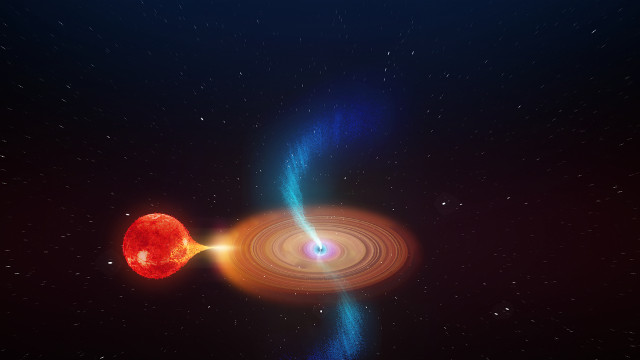
The top image (Courtesy ICRAR. All rights reserved) shows an artistic concept of the black hole V404 Cygni while emitting a jet of materials. The bottom image (Courtesy ICRAR. All rights reserved) shows an artistic concept of the entire V404 Cygni system with materials that are torn from the star and end up in the accretion disk that surrounds the black hole.
Periodically in the V404 Cygni system violent bursts occur when the black hole swallows up materials in huge amounts and at the time of the 2015 one, which lasted about a couple of weeks, it was possible to examine V404 Cygni with much more sophisticated instruments than the previous events. Nevertheless, studying this black hole is complicated because of its peculiarities: a previous research measured its corona’s magnetic field discovering that it’s much weaker than the estimates made previously and the jets of materials it emits come from different directions and not only from the poles, as normally happens, changing direction quickly because the growth disk that surrounds the black hole oscillates generating a movement similar to that of a spinning top.
To be able to study the different orientations of the jets of materials emitted by the black hole V404 Cygni, the authors of this new study created not a single image from hours of observations with a radio telescope but 103 images 70 seconds long each and then joined them together in a movie that showed the jets’ orientation changes. This task was performed using the radio telescopes of the Very Long Baseline Array (VLBA) network in the USA to detect the radio waves emitted by that system while X-rays, useful to understand the events taking place in the inner region of the accretion disk, were detected using various space telescopes including ESA’s Integral (INTErnational Gamma-Ray Astrophysics Laboratory) high energy observatory, which observed the burst continuously for four weeks in 2015.
Thanks to the X-ray detections, the researchers found evidence that the inner part of the accretion disk surrounding the black hole V404 Cygni is misaligned with respect to the black hole, most likely because the black hole’s spin is tilted with respect to its companion’s orbit. The origin of that misalignment is another object of study and a possible explanation is that it’s the consequence of a push received during the explosion in supernova of the progenitor star.
Dr. Gemma Anderson, another author of the article and also of Curtin University, stated that when there’s a misalignment like that of V404 Cygni one can expect to see it when a black hole swallows materials very quickly and this could include other explosive and bright phenomena such as a supermassive black hole in a similar situation or the destruction of a star by a black hole.
The authors of this research found a way to study the V404 Cygni black hole despite its oscillations and this could be useful in other similar cases. The environment around a black hole is really extreme, in this case it’s even more so and this research is really useful to better understand the observed events.